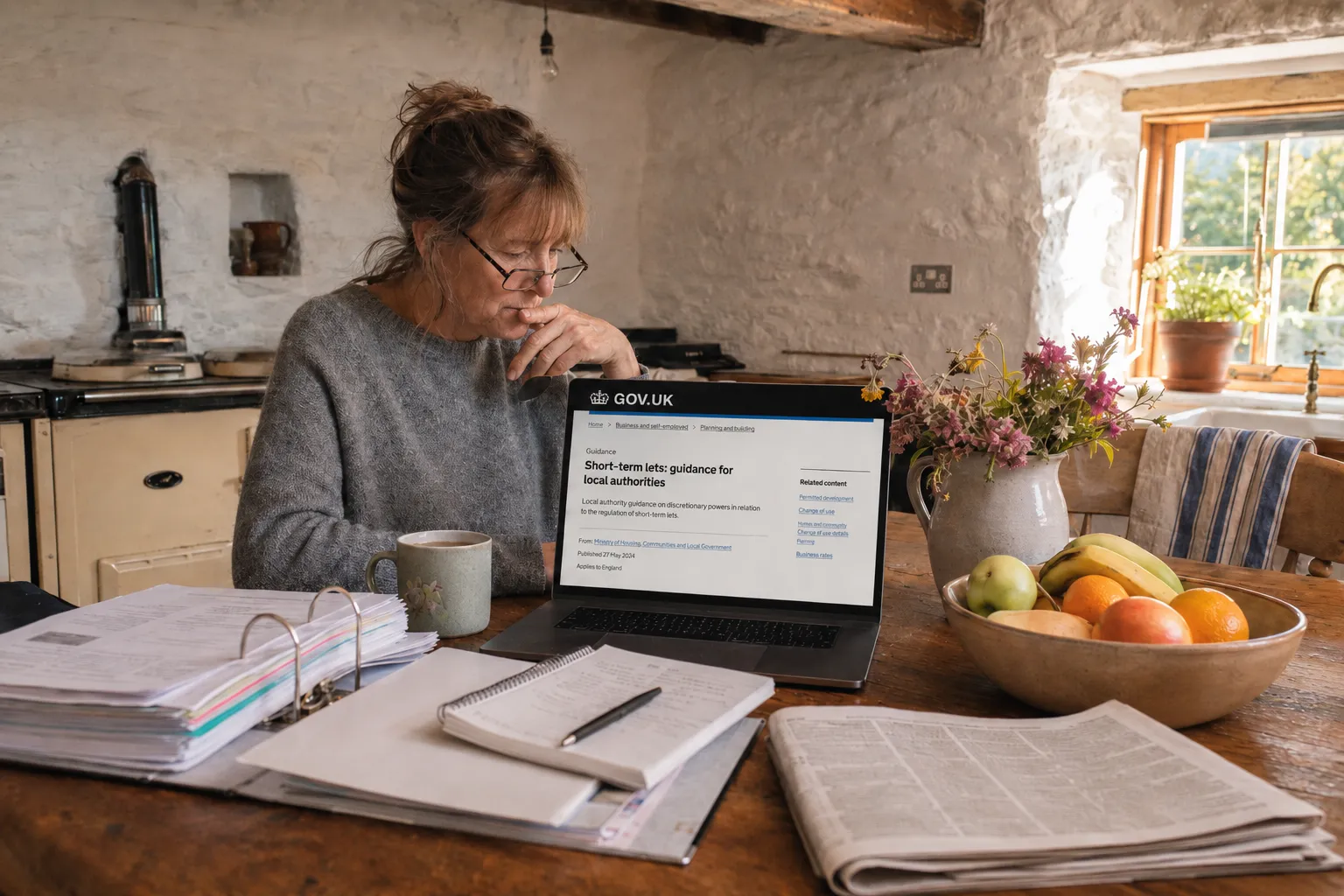
England’s short-term let register is required by law and is still not live. There is nothing to register, nowhere to register, no fee and no published regulations. The guidance now names a month: GOV.UK says the scheme “is expected to begin in March 2027”, a change it made on 2 October 2026.
That gap between “required by law” and “does not exist yet” is where most of the confusion lives, and most of what ranks for this question makes it worse by presenting guesses as detail. This page does the opposite: it separates what the law says, what ministers have said, and what nobody can tell you yet, with a date on every claim. We re-check it on a rolling cycle, and the facts-checked stamp above tells you when that last happened.
Short-term let registration in England: the status today
There is no register to join. The newest thing a minister has said about it came on 3 September 2026, when the Culture Secretary, Lisa Nandy, answered a question in the Commons about when the register would go live: “in his first week in the job the Prime Minister asked me to accelerate this work, and that work is now continuing apace. In any case, the register will be up and running in full by March.”
That quote never carried a year. She said “by March” in September 2026, so March 2027 was the natural reading, and the press printed March 2027 without noting that she had not said it. This page declined to put the year in her mouth and recorded what Hansard contained.
On 2 October 2026 the guidance settled it. GOV.UK updated the self-catering page with the note: “Updated ‘Register your property (not yet in force)’ section to state that the mandatory national registration scheme is now expected to begin in March 2027.” The published position and the ministerial position now agree, and the year is no longer an inference.
What has not changed is the substance. The section is still headed “Register your property (not yet in force)”, there is still no portal, no published fee, and no regulations on legislation.gov.uk under the enabling power. A date in guidance is a plan, and this scheme has had plans before.
Two pages are worth watching, and they are the same two we re-check for this tracker: the government’s self-catering guidance for England and its scheme delivery page. When the scheme goes live or gets a date, it will appear there before it appears anywhere else.
What the law actually says
The legal spine is section 228 of the Levelling-up and Regeneration Act 2023, in force since 26 December 2023, and its first line is stronger than most coverage suggests: the Secretary of State “must by regulations make provision requiring or permitting the registration of specified short-term rental properties in England”. Must, not may. A scheme is not a policy aspiration that could quietly die; it is a statutory instruction waiting on regulations.
Three other things sit in that section and repay reading:
- The definition is broad. A short-term rental property is, in outline, a dwelling or part of one provided by a host to a guest for money, where it is not the guest’s principal residence and the host acts in the course of a trade or business. That comfortably covers a whole-home Airbnb.
- Fees are optional. The regulations “may” provide for charging fees. Anyone quoting you the cost of registering in England is quoting a number that has not been set.
- Enforcement is sketched, not priced. The section allows enforcement through civil sanctions, but the amounts and mechanics only exist once regulations write them down.
How we got here, dated
October 2023
The Levelling-up and Regeneration Act becomes law. Section 228 orders ministers to create a registration scheme for short-term lets in England by regulations.
December 2023
Section 228 comes into force. The duty is live; the regulations that would give it effect are not.
February 2024
DCMS confirms the shape: mandatory, national, digital, promised as light touch and low cost, and not for hotels, hostels or B&Bs.
September 2024
The government service, Register a property as a short term let, passes its alpha assessment and is cleared to build a private beta.
July 2025
The tourism minister says the register will be live by April 2026, voluntary at first, mandatory later.
October 2025
The scheme enters user testing with real hosts.
April 2026
The target month passes with no launch. The Commons is told the planned launch is now later in 2026.
May 2026
GOV.UK guidance is updated and still reads expected to begin in 2026; its register section still says not yet in force.
September 2026
The Culture Secretary tells the Commons the Prime Minister has asked her to accelerate the work, and that the register will be up and running in full by March. No year is given.
2 October 2026
GOV.UK changes the guidance to say the scheme is expected to begin in March 2027, the first time the published wording names a month.
You are here · 10 October 2026
Still nothing to register, no fee and no regulations published. The expected start is now March 2027, in the guidance as well as from the minister.
The pattern in that timeline is worth naming: the legal duty and the digital build are real and progressing, and every public date so far has slipped. The register passed its alpha assessment in September 2024, went into user testing with real hosts in late October 2025, and missed its promised April 2026 launch, with Parliament told in the same month that the launch was planned for later in 2026. A scheme arriving this year is still the government’s stated position; a scheme arriving on any particular date is not something anyone can honestly tell you.
What is confirmed, and what nobody can tell you yet
The voluntary-first plan deserves its own note, because it sits between the two columns. The tourism minister said, in July 2025, that the register would open voluntarily before becoming mandatory. That is a real, reported ministerial statement and a sensible way to launch a service, but it is not in the Act and not in published guidance, so treat the sequencing as likely rather than settled.
What changed at this review
This page is re-checked every 45 days and the last check was 17 September 2026. One thing moved, and it closes the gap this page has been tracking since August.
- GOV.UK named a month. On 2 October 2026 the self-catering guidance was updated with the note: “Updated ‘Register your property (not yet in force)’ section to state that the mandatory national registration scheme is now expected to begin in March 2027.” The section now reads “It is expected to begin in March 2027”, where it previously said 2026.
- The two positions now agree. This page has carried a disagreement since the Culture Secretary said “by March” without a year on 3 September 2026: the guidance said 2026, the minister implied March 2027, and we recorded both rather than picking one. The guidance has now moved to the minister’s timing, so the year is sourced rather than inferred.
- The scheme delivery page has not moved. It still carries only its original publication date of 19 February 2024 and still says detail will follow “later in the year”.
- Nothing else moved. Still no portal, no published fee, and no regulations on legislation.gov.uk under the enabling power. The section is still flagged “not yet in force”.
- A date in guidance is still a plan. This scheme has been given dates before and missed them, which is why the timeline above lists every one of them. March 2027 is now the published expectation, not a commencement date in law.
Why the detail you read elsewhere does not exist yet
Search this topic and you will find pages quoting a registration fee, a penalty for non-compliance, and rules about displaying your registration number on every listing. As of this check, none of that exists in any English legal source, because the regulations that would create those details have not been laid. Some of the circulating figures are real numbers borrowed from the wrong country: Scotland’s licensing scheme and Wales’s registration scheme both carry genuine, sourced penalties, and our nation-by-nation rules guide has those with dates. England has no equivalent numbers yet. When it does, this page will carry them with a link to the instrument that created them.
The practical test is simple: if a claim about the English scheme comes with a specific figure and no citation to legislation.gov.uk or GOV.UK, it is a guess.
What an owner in England should do now
Nothing, on registration itself. There is no queue to join and no advantage to buying help with a process that does not exist. Two things are genuinely worth doing:
- Be registration-ready by being legal today. The evidence a registration scheme is expected to care about, a fire risk assessment, gas safety record, electrical report and compliant furnishing, is already the law for paying guest accommodation. If your paperwork folder is complete now, registration day is an afternoon of admin. What a UK Airbnb must legally have sets out the physical spec, and the wider duties live in the rules guide.
- Treat “register now” services with suspicion. Until a GOV.UK service exists, nobody can register your property, and a paid service offering to do so is selling you either a placeholder or a mailing list. When the real scheme opens, the government’s stated design intent is light touch, low cost and simple to use, delivered online.
If you are earlier in the journey than that, registration is step-two territory in the full setup order: worth knowing about, not worth waiting for.
How this fits with Scotland, Wales and London
England is the last of the three nations to build its scheme: Scotland has required a licence before the first booking since October 2023, Wales’s register is open now with a deadline of 31 March 2027, and London runs its own 90-night planning cap on top of everything else. Those systems have real dates and real penalties today, and the rules guide keeps all four current, nation by nation. This page tracks England’s scheme only, because England is where the uncertainty is.
Corrected 23 October 2026. The paragraph above said Wales “opens mandatory registration in October 2026”. The Welsh Revenue Authority’s register is open now, with every provider due on it by 31 March 2027 (GOV.WALES registration overview, last updated 8 October 2026, read 23 October 2026). England’s facts on this page were not re-checked at this correction.
One planning point to keep separate: the mooted new planning use class for short lets and its permitted development rights are a different set of measures from registration, run separately by government, and also not in force. Registration is a data scheme; the use class would be a planning change. Conflating them is the second most common error on this topic, after inventing the fee.
If you are weighing up whether a property makes sense as a short let while all this settles, get a free Airbnb valuation. It looks at the property as it stands under today’s rules, flags what compliance would actually apply to it now, and puts realistic numbers underneath the decision, with the assumptions visible.
Frequently asked questions
When will the England registration scheme actually start?
The published expectation is now March 2027: GOV.UK changed its wording on 2 October 2026 from “expected to begin in 2026” to “expected to begin in March 2027”. That is a plan rather than a commencement date, and this scheme has missed published targets before, including April 2026, which was to be voluntary first. What can be said is that the legal duty is binding, the digital service has been through alpha assessment and user testing, and the launch, when it comes, will be announced on GOV.UK.
Will registering my Airbnb in England cost money?
Unknown. Section 228 allows regulations to charge fees but does not require them, and no fee has been set. The government’s stated design intent is a light touch, low cost scheme. Any specific figure you see quoted for England today is invented, or borrowed from Scotland’s or Wales’s very different schemes.
Do I need to do anything about registration now?
No. There is nothing to register and nowhere to register. The useful preparation is having your safety paperwork complete and current, because those duties already apply and are what a register is expected to surface. An owner who is compliant today should find registration, whenever it arrives, a form-filling exercise.
Is the registration scheme the same as the planning use class change?
No. They are separate measures. Registration, under section 228, creates a national record of short-term lets and is the scheme this page tracks. The proposed planning use class and its permitted development rights would change how planning law treats short lets, are being taken forward separately, and are also not in force. A property could eventually be affected by both, one, or neither.
Sources
- legislation.gov.uk: Levelling-up and Regeneration Act 2023, section 228 (in force 26 December 2023; checked 2026-09-17)
- GOV.UK: Letting out a self-catering holiday home in England: rules and regulations (updated 2 October 2026, the update that moved the expected start to March 2027; checked 10 October 2026)
- GOV.UK: Delivering a registration scheme for short-term lets (published 19 February 2024, no update history, unchanged at this check; checked 2026-09-17)
- GOV.UK: Register a property as a short term let: alpha assessment (assessed 25 September 2024; checked 2026-08-03)
- Hansard: Short-term Lets: Regulation, House of Commons, 3 September 2026 (Volume 790; the Culture Secretary: “the register will be up and running in full by March”, with no year stated; checked 2026-09-17)
- Hansard: Short-term Holiday Lets: Registration, House of Commons, 13 April 2026 (checked 2026-08-03)
- ITV News: Holiday let register will go live in April, says tourism minister (25 July 2025; reported ministerial statement)