A UK Airbnb needs three groups of things: the items the law expects of paying guest accommodation, the items guests will not book without, and the items that earn the review. Most furnishing checklists start at the sofa and never reach the first group, which is how owners end up with a fire risk assessment they cannot pass.
This is the room-by-room list, published in full. Two things in it are not on the guides currently ranking for this question: the furniture label that stopped being a legal requirement in October 2025, and the alarm standard that applies to a property you charge people to sleep in, which is not the same standard as the one that applies to a house.
What a UK Airbnb must legally have
Fire safety law applies to you the moment you charge someone to stay, even for one night. The government’s own guide for this property type puts it plainly: the law applies “if you are charging someone to stay in your property as a guest and it is not being occupied as a private dwelling, even if it is just for one night”. In England the duty sits under the Regulatory Reform (Fire Safety) Order 2005, and it lands on the “responsible person”, which is usually you as the owner.
- A suitable and sufficient fire risk assessment. This is the actual legal duty, and since 1 October 2023 it has to be written down whatever the size of the property: does a holiday let need a fire risk assessment? covers the duty itself. Everything below is what a competent assessment normally expects to find. Nobody else can do it for you: fire and rescue services give advice but cannot write it for you.
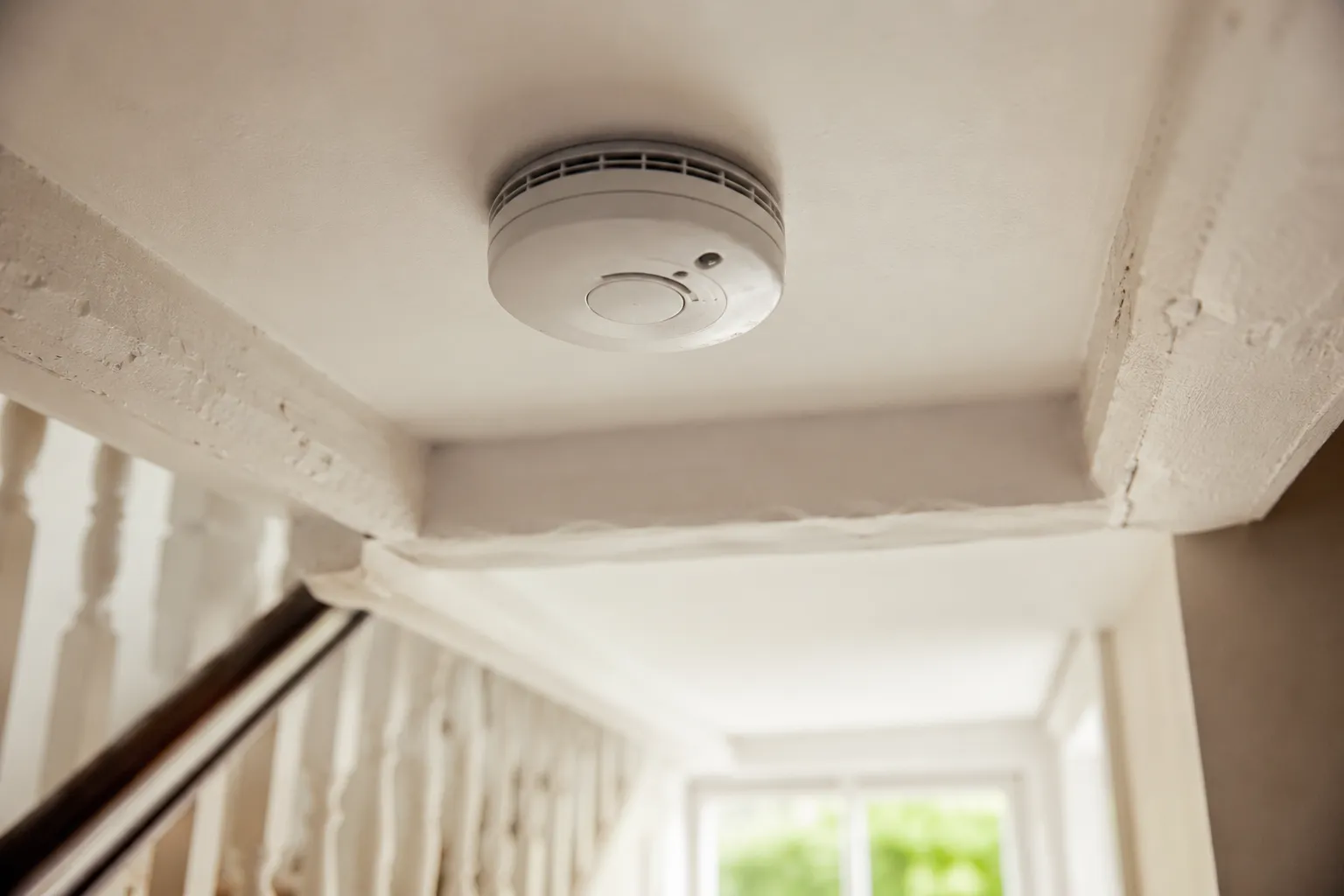
- Interlinked smoke and heat alarms, sited by room rather than by storey. The standard is set out in the next section but one, and it is higher than the one most guides quote.
- A carbon monoxide alarm where the living accommodation contains a gas or solid fuel-burning appliance.
- Upholstered furniture that complies with the Furniture and Furnishings (Fire) (Safety) Regulations 1988 (as amended), evidenced by the permanent label. This is where second-hand furniture catches owners out.
- An annual gas safety check on every gas appliance and flue, by a Gas Safe registered engineer, if the property has gas (how the check, the record and the display rule work). The Health and Safety Executive is explicit that landlords’ gas duties cover rented holiday accommodation such as cottages, chalets, flats and caravans.
- An electrical installation inspected and tested at least every five years by a competent contractor, with a fuse board in good condition and correctly labelled.
That list is England-led, because the fire guidance it comes from is issued for England. Scotland licenses short-term lets and attaches its own conditions, and Wales’s registration scheme is open now with a 31 March 2027 deadline, so check the rules that apply in your nation before you buy anything. If the property is not yet let, the full running order, from permission through to launch, is in our guide to setting up an Airbnb.
Corrected 23 October 2026. This paragraph said Wales “opens registration later in 2026”. The Welsh Revenue Authority’s register is open now, with every provider due on it by 31 March 2027 (GOV.WALES registration overview, last updated 8 October 2026, read 23 October 2026). The rest of this page is due its full review on 25 October.
The fire-safety label to look for on furniture, and the one that stopped mattering
Look for the permanent label. The swing label stopped mattering in 2025.
The Furniture and Furnishings (Fire) (Safety) (Amendment) Regulations 2025 removed every requirement relating to the display label, the card tag commonly known as the swing label, from 30 October 2025. The government’s stated reason was that “the permanent label carries all relevant compliance information”. The same amendment explicitly did not touch the permanent label: those obligations, under regulation 11 of the 1988 regulations, are unchanged.
So any furnishing guide still telling you to look for a swing label is describing a requirement that no longer exists, and worse, is pointing you at the wrong label. The permanent one is the sewn-in fabric label, and it is the one that has to be there.
CARELESSNESS CAUSES FIRE
1Maker or importer, and postcode
2Batch or identification number
3Date of manufacture or import
4Every filling material described
5Every covering material described
6Whether an interliner is included
Sewn to the item itself: under a seat cushion, inside the base cover, along a seam. It survives the life of the furniture, which is exactly why it is the evidence.
The permanent label: the one that must be there
DISPLAY LABEL
Requirement removed
30 October 2025
The swing tag: stop looking for it
Three practical consequences for a property you are furnishing:
- Second-hand upholstery without a permanent label is not a bargain. With no label, you have no way to show the item complies, and the fire risk assessment has to deal with that. Marketplace sofas and armchairs are where this bites hardest.
- Mattresses and bed bases sit outside that particular labelling schedule, which covers upholstered furniture and covers. Buy those new and keep the retailer’s paperwork rather than trying to reason backwards from a label that was never going to be there.
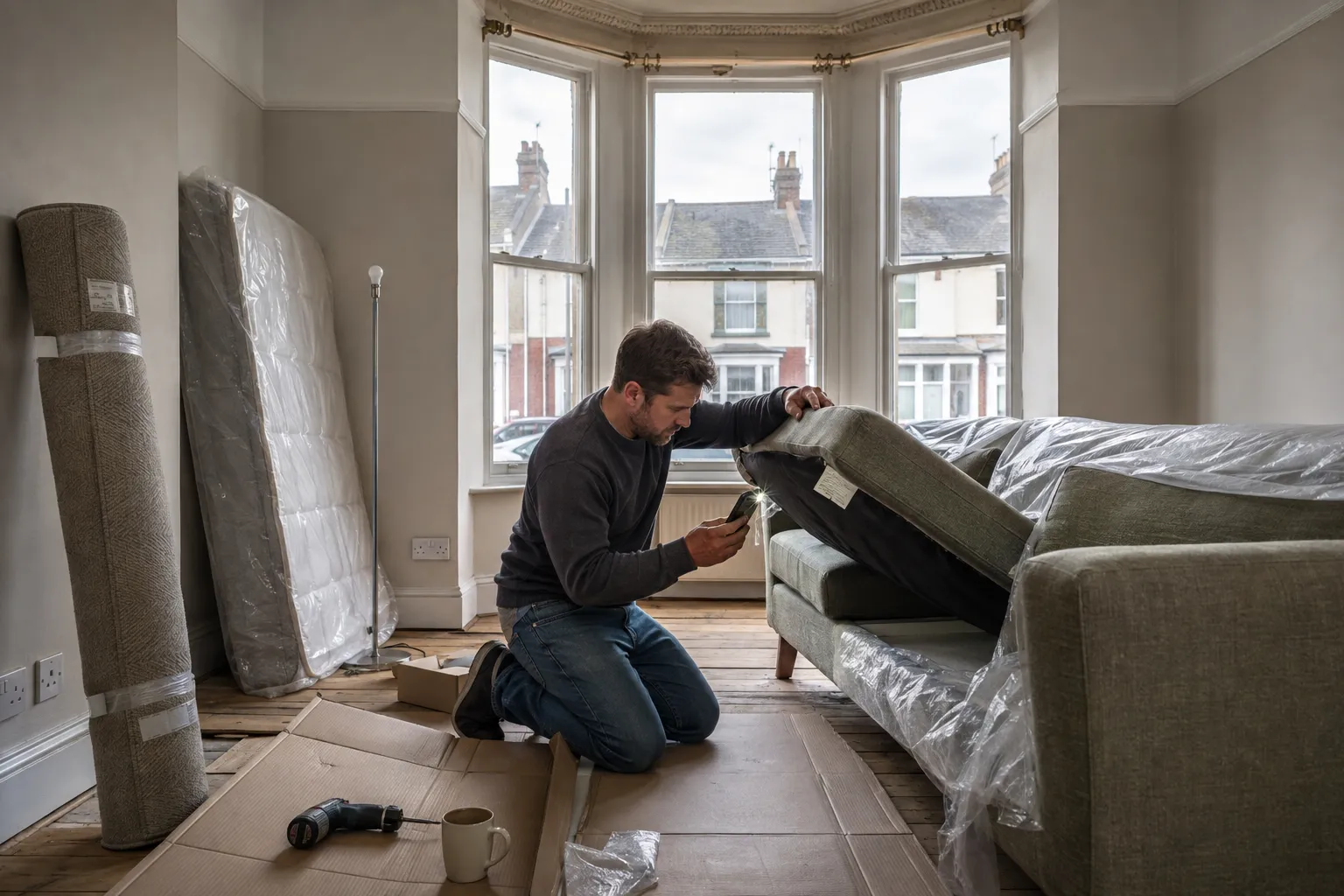
- Photograph every label as it arrives. Ten minutes with a phone at delivery is the difference between an evidenced assessment and a room full of furniture you can only vouch for from memory.
The regime behind that label is being rewritten, and the label duty is not part of it. The Office for Product Safety and Standards consulted on reforming the 1988 regulations between 31 March and 23 June 2026, proposing that compliance be demonstrated by a smoulder test, along with pragmatic testing routes and scope adjustments, so that far less chemical flame retardant is needed. That consultation closed and GOV.UK still says “We are analysing your feedback”, with no response date and no transition timeline published. Two things follow for anyone furnishing a property now. The rules to buy against today are the ones above, unchanged. And the proposals concern how furniture is tested and what falls in scope, so nothing in them removes the permanent label you are being told to look for.
The alarm standard for a property people pay to sleep in
This is the part most furnishing guides get wrong, because they import the standard that applies to rented homes. Paying guest accommodation is assessed differently, and the government’s guide for small guest accommodation sets out what that means room by room.
Where there is no full detection and alarm system, which is the normal case in a house, cottage or flat, it expects interlinked domestic smoke and heat alarms “in all areas where a fire might start”:
Roof void: detection needed up here too if it holds combustibles or ignition sources
Bedroom
Bathroom
Bedroom
Lounge
log burner
Hall and stairs
Kitchen
hob or boiler
A CO alarm goes wherever a room has a gas or solid fuel appliance: the lounge log burner, the kitchen hob or boiler. Bathrooms normally need nothing.
Every alarm interlinked by wire or radio, so one detecting sounds them all. Mains powered with tamper-proof battery backup, known as Grade D1: sealed-battery alarms are accepted only as a two to three year stopgap. Test the lot at every changeover.
Two of those placements catch owners out. Bedrooms are on the smoke list because guests sleep in rooms they do not know, sometimes after a drink, sometimes with a phone on charge, and the guide names bedrooms specifically. Kitchens get heat alarms rather than smoke alarms because steam and cooking fumes set a smoke head off, and a false alarm at 7am is a review, while a taped-over alarm is a disaster.
If you take one thing from this post, take that: an alarm on each landing is the domestic standard, and it is not what this property type is assessed against. Budget for the alarms at the same time as the beds, because retrofitting interlinked mains alarms after the decorating is finished costs more and looks worse.
The room-by-room Airbnb furnishing checklist
Everything below assumes the safety list above is already handled. Must-have means a guest expects it and its absence shows up in reviews or in your booking rate. Nice-to-have means it earns its place in some properties and is dead money in others.
The spine of this list is the baseline set our own owner onboarding form asks every new property to confirm before it goes live: thirty-six items, deliberately weighted for UK properties, where anything missing is a job to do before launch rather than an upgrade to think about later. A drying rack rather than a tumble dryer. Heating rather than air conditioning.
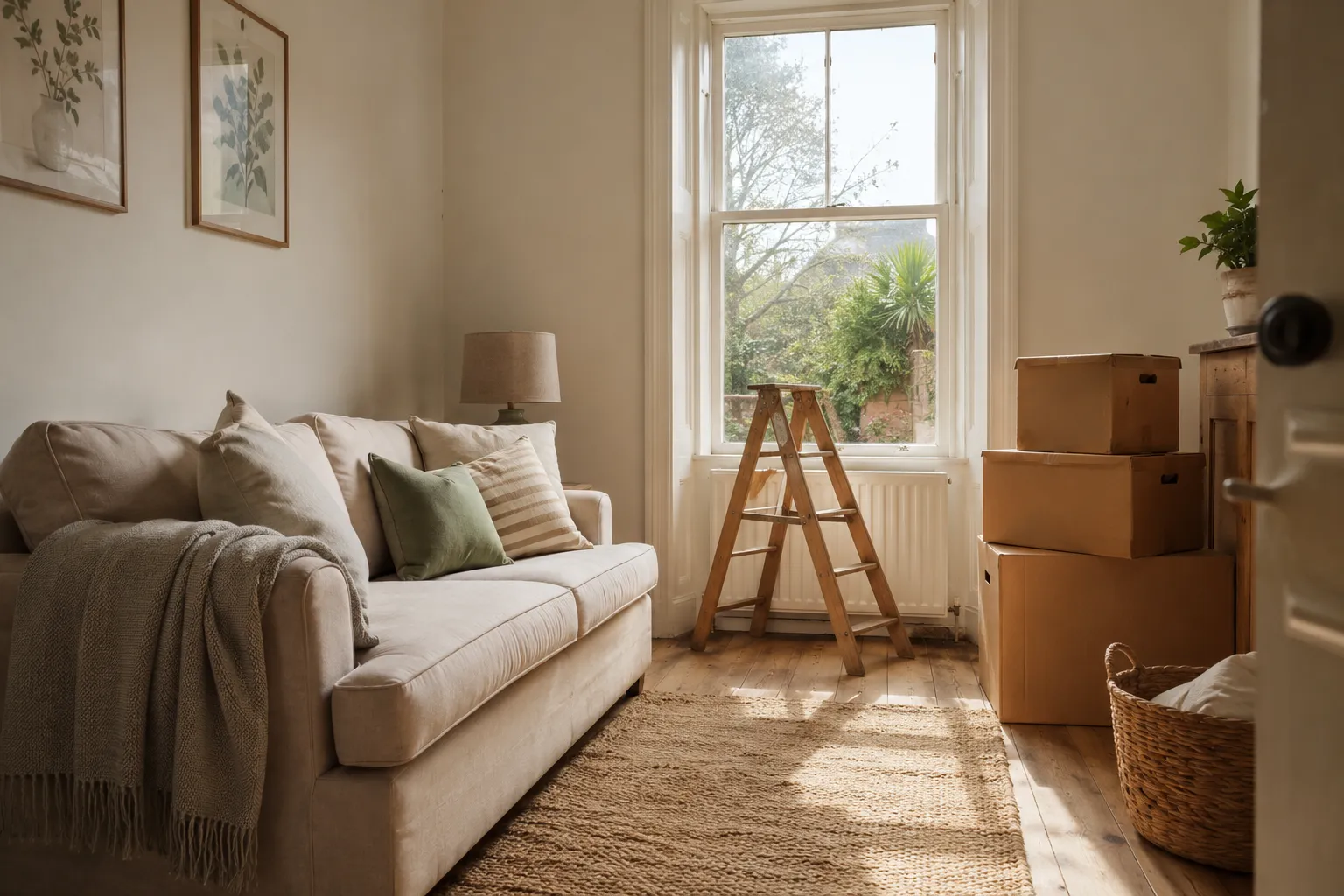
One line worth adding to every room: sleeping capacity has to be honest. A sofa bed that “sleeps two” in the listing but ruins two backs in practice is not extra capacity, it is a review waiting to happen.
Where to spend, and where not to
The list above tells you what to buy. This tells you where the money actually earns.
Spend on the bed and the mattress. It is the one item every guest uses for eight hours a night and mentions by name when it disappoints. A good mattress outlasts three cheap ones, and no amount of styling compensates for a bad night’s sleep.
Spend on the shower and the hot water. Pressure and capacity are structural: you cannot fix them with a throw. A property that runs out of hot water after two showers has a maximum sleeps number that is a fiction.
Spend on Wi-Fi. Remote work, families streaming in separate rooms, and guests who check the speed before booking. It is now infrastructure, and guests treat it as a utility.
Spend on linen, and buy three sets per bed. Changeovers are the tightest part of the operation; the third set is what stops a delayed laundry return becoming a cancelled booking.
Do not spend on styling that breaks. Decorative items with small parts, fragile ceramics, anything white and unwashable, or furniture that photographs beautifully and wobbles by August. Every breakable is a changeover job and a replacement cost.
Do not spend on the big-ticket extras before the property has a booking history. Hot tubs and fire pits change what you can charge, and also change your cleaning, insurance and maintenance. That is a decision to make with real numbers in front of you, not on day one.
Do not spend on brand-new everything when the label is what matters. A well-made second-hand table or wardrobe is fine. It is upholstery, mattresses and anything with a fire-safety label that should be new or evidenced.
What guests complain about that owners never anticipate
The reviews that cost you are rarely about missing luxuries. They are about small frictions in a property that is otherwise fine:
- Hot water that runs out before the second shower
- One bin, no bin bags, and no idea which day the collection is
- No socket near the bed, so somebody unplugs a lamp to charge a phone
- Dim, cold overhead lighting and no lamps
- A shower that is technically a shower
- Heating controls nobody can work out, in a cottage in February
- Nowhere to dry coats, boots or towels after a wet day
- A kitchen with no sharp knife, no chopping board and one small saucepan
- A “quiet” room over a road, undisclosed
- Instructions that exist in your head and nowhere else
Every one of those is cheap to fix before the first booking and expensive to fix after a written review. If a listing is already live and underperforming, the same logic applies in reverse: work through why an Airbnb stops getting bookings before you spend on more furniture.
The things that are not furniture but belong on the list
- A house manual, written for someone who has never been there: heating, hob, Wi-Fi password, bins, parking, what to do if the water stops.
- Fire safety information for guests, which the government’s guide expects you to provide, along with the escape plan the risk assessment produces.
- Spare keys, and a plan for when a set is lost, which happens at 11pm on a Saturday.
- A way to report a problem that does not depend on you seeing a message.
- Your certificates and records, kept together: the gas safety record, the electrical report, the fire risk assessment, and the furniture label photographs.
- A consumables restock list the cleaner works from, so nobody discovers the last toilet roll at the same time the guest does.
What it costs to furnish, and why we will not give you one number
There is no honest single figure, and the ranges published online mostly come from businesses selling furniture packages, which makes them a price list rather than a benchmark. What actually drives your number:
- Sleeping capacity, because beds, linen sets, crockery and seating all scale with it
- Bathrooms, the most expensive rooms per square metre to bring up to standard
- Whether the kitchen is being equipped from zero or already has appliances worth keeping
- What already exists and complies, which is where the label check pays for itself
- The safety work, especially interlinked mains alarms in a property that has none
- Lead times, because a delivery date can push your launch past a whole season
Price your own list from the checklist above rather than from someone else’s average. Then check the number against what the property should realistically earn: what an Airbnb can earn in the UK is the other half of that sum, and a furnishing budget only makes sense next to it.
If you would rather have both halves answered at once, get a free Airbnb valuation. Part of what we look at is the property’s furnishing level and presentation standard, so the estimate comes with a view on what is missing before it could realistically let, and what that changes.
What changed at this review
Re-checked 17 September 2026, 45 days after the last check. Every source was re-read at origin.
- One genuine development. The government consulted on replacing the 1988 fire-test regime with a smoulder test. The consultation closed on 23 June 2026 and the outcome is still pending, which is covered in the labelling section above.
- The labelling position is unchanged. Schedule 7 of the 1988 regulations is still in force with no outstanding effects recorded, and the six particulars the permanent label must carry are exactly as listed. The 2025 amendment that removed the display label is unchanged.
- The alarm standard is unchanged. The government’s guide for small paying-guest accommodation is still the 20 January 2025 edition.
- Gas and platform requirements are unchanged. HSE still lists rented holiday accommodation among the property types covered by the annual landlord gas safety check, and Airbnb’s essential amenities are the same five items.
Nothing on this page needed correcting. The reform is the thing to watch, and it is why this post keeps a 45-day cycle rather than an evergreen one.
Frequently asked questions
What does an Airbnb legally need to have in the UK?
Fire safety law applies from the first paying night. In England that means a suitable and sufficient fire risk assessment, and in practice the alarms, compliant upholstered furniture, an annual gas safety check where there is gas, and a five-yearly electrical inspection that a competent assessment expects to find. Scotland and Wales add their own licensing and registration requirements on top, which the rules guide covers nation by nation.
Can I use second-hand furniture in an Airbnb?
Yes, with one hard limit: upholstered items need the permanent fire-safety label, and without it you cannot evidence compliance. Tables, wardrobes, chests of drawers and bed frames are a different matter and second-hand is often the better buy. The label to check is the sewn-in permanent one; the card swing label stopped being a legal requirement on 30 October 2025.
How much does it cost to furnish an Airbnb?
It depends on sleeping capacity, the number of bathrooms, how much of the kitchen already exists, and how much safety work the property needs. We do not publish a single figure because the ones circulating online come mainly from companies selling furnishing packages. Price your own list from the checklist above, then judge it against what the property should earn rather than against an average.
What are Airbnb “Essentials”?
Airbnb’s own definition is narrower than most people assume. To tick the Essentials amenity, a listing provides toilet paper, soap for hands and body, one towel per guest, one pillow per guest, and linen for each guest bed. That is the platform’s floor for listing at all, and a property that stops there will read as bare next to anything competently kitted out.
Sources
- GOV.UK: Product regulation: fire safety of domestic upholstered furniture (consultation on reforming the 1988 regulations, ran 31 March to 23 June 2026; closed, outcome pending at this check; checked 2026-09-17)
- GOV.UK: A guide to making your small paying-guest-accommodation safe from fire (Article 50 guidance under the Regulatory Reform (Fire Safety) Order 2005; published 30 March 2023, updated 20 January 2025, unchanged at this check; checked 2026-09-17)
- GOV.UK: Furniture and Furnishings (Fire) (Safety) (Amendment) Regulations 2025 (published 30 April 2025, in force 30 October 2025, unchanged at this check; checked 2026-09-17)
- legislation.gov.uk: Furniture and Furnishings (Fire) (Safety) Regulations 1988, Schedule 7 (permanent labelling; in force, and legislation.gov.uk records no outstanding effects for this schedule; checked 2026-09-17)
- HSE: Gas safety, landlords and letting agents (rented holiday accommodation is covered; annual check; checked 2026-09-17)
- Airbnb: Providing essential amenities for guests (help centre article 2343, the same five items at this check; checked 2026-09-17)