Self check-in for an Airbnb comes down to four decisions: the device on the door, when the guest gets the code, a door that opens from inside without a key, and permission to fix anything to the building. Get those right and guests let themselves in at any hour, and the check-in rating they leave shows it.
The device is the quickest of the four to settle. The other three are where UK properties go wrong, so they get most of the space here.
The three ways guests let themselves in
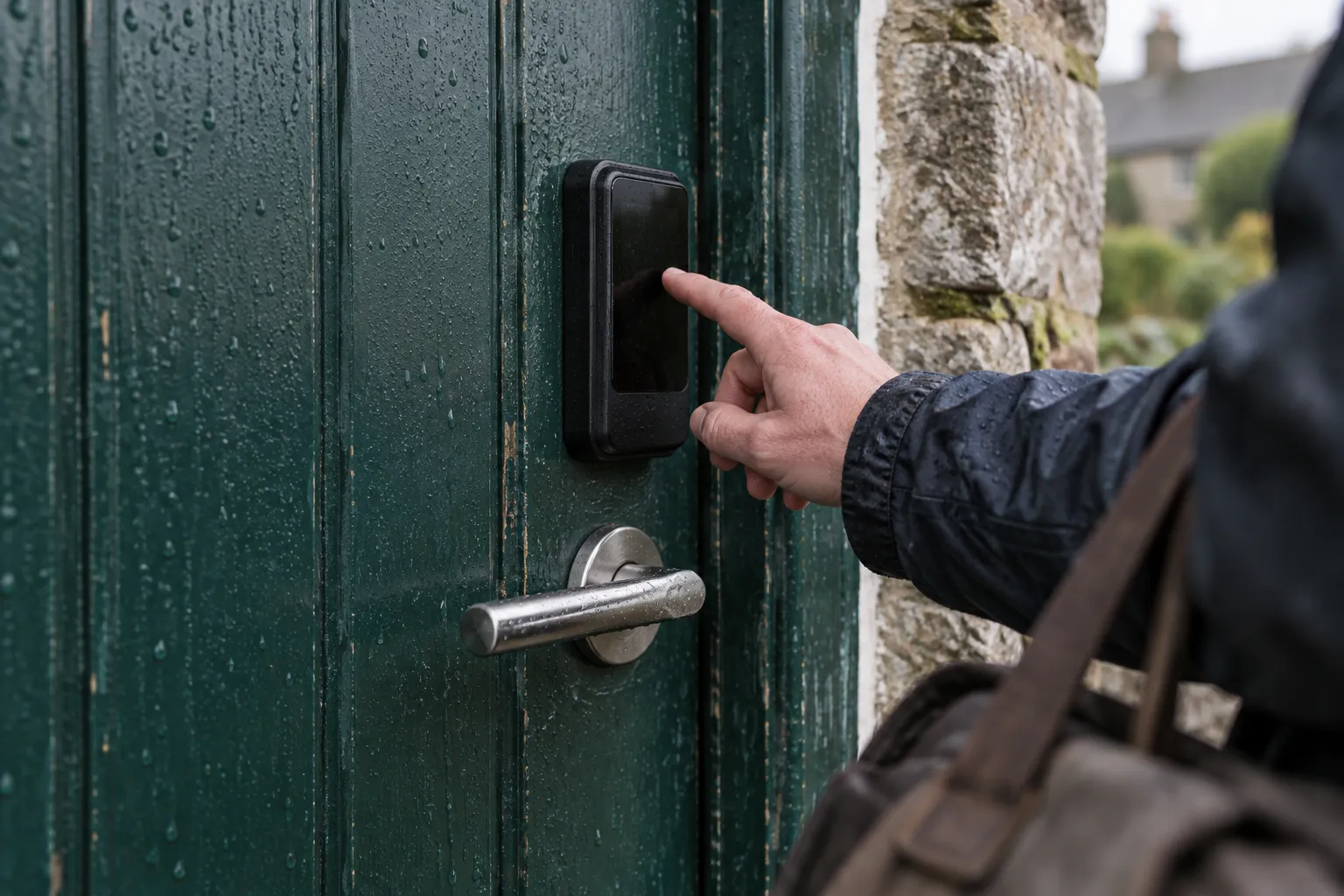
Airbnb’s guest guide lists three ways in, and two of them are self check-in. A lockbox is a “metal box with a key inside, opened with a combination code”. A keypad or smart lock means guests “enter a code directly on the door”. The third, an in-person meeting, is the one self check-in replaces.
Split the keypad from the connected smart lock and you have three devices to choose from. What separates them in practice is who changes the code, and when.
- A key safe holds a real key, so the property’s own lock stays exactly as it is. The code lasts until somebody changes it by hand. Change it between every booking, or every guest who has ever stayed knows how to get in.
- A keypad lock replaces the lock itself. You set and change codes on the lock or in its app, so there is no key to lose, though the code changes still depend on you remembering.
- A connected smart lock links to your Airbnb account and issues a code for each reservation automatically. Airbnb’s requirements are specific: a lock from Schlage, Yale or August “that connects to wifi and has a keypad or touchscreen”, and “you can’t connect a lock that only has Bluetooth.”
A rural cottage with patchy broadband changes the sums. A connected lock depends on the wifi it was paired through, so a key safe or a standalone keypad is the sturdier choice where the router drops out in a storm. Wherever you land, Airbnb’s own advice is to “add a backup entry method in your arrival guide.” A key safe holding a spare key is the simplest backup there is.
When the guest gets the code
The timing depends on the method, and the difference matters for how you write your messages.
For a connected smart lock, Airbnb says guests “receive their door code in an email after they book and get a reminder when it’s time to check in.” The code itself only works from check-in time, and “door codes are activated at check-in time and expire 30 minutes after checkout.” Move a guest’s arrival or departure in the reservation and the code’s window moves with it.
For every other method, the code travels with your check-in instructions. Airbnb tells guests that hosts “provide detailed check-in instructions 48 hours (local time) before your reservation starts”, and that with self check-in “your door or lockbox code will be emailed and sent as a message 48 hours before your arrival.”
Airbnb Help Centre and Resource Centre
A connected lock's code only works for the stay
When each code reaches the guest (dots) and when it opens the door (bars). Stages are shown in order; the spacing is not to scale.
Connected smart lock
Sent at booking, live for the stay. A new code for each reservation, with no code to change by hand.
Key safe or standalone keypad
Sent 48 hours before, live until you change it. The hatching is the exposure: the code works before and after the stay.
That hatched bar is the whole case for changing a key safe code between guests. Write the change into the changeover routine, and send the new code in the 48-hour message, so a code is only ever in the hands of the guest about to use it.
A front door guests can open without a key
A front door that guests can open from inside without a key is the one part of self check-in that fire safety law reaches. The Home Office guide for small paying guest accommodation in England, issued under the Regulatory Reform (Fire Safety) Order 2005, says the front or back door must be easy to open and must never need a key to open from the inside, and that “a simple latch or thumb turn is usually good enough.” Behind the guide sits article 14(2)(f) of the Order itself: emergency doors “must not be so locked or fastened that they cannot be easily and immediately opened” by anyone who may need them.
The guide then goes a step further: “you may need to consider whether all guests are able to open these doors. A simple single action turn handle or lever will often be more appropriate.” A stiff thumb turn that a guest with arthritis cannot grip fails the same test as a keyed lock.
Scotland’s guidance for self-catering premises says the same in its own words. The final exit door “should be capable of being easily opened from the inside without the use of a key”, and it leaves the choice of how to secure the door to the occupiers. Wales has its own guide issued under the same Fire Safety Order, so a Welsh property should be checked against that.
Fire safety guidance, England and Scotland
Two faces of the same front door
Every point in the guidance concerns the inside face, where nothing should stand between a guest and the street.
Outside
Any method you choose
Key safe, keypad or smart lock. This is where the code is entered.
Inside
One action, no key, no code
A latch, thumb turn or lever handle a guest can work in the dark.
- Fails: a lock that needs the key on both sides, with the key kept in a drawer.
- Fails: a keypad deadbolt that asks for the code to get out as well as in.
- Check: a thumb turn too stiff or small for every guest to grip.
This is where self check-in quietly breaks the rule. An owner fits a keypad outside and keeps the old key-operated deadlock as well, for security while the house is empty. Or a guest finds a door that only opens with the key from the key safe, and that key is now in a coat pocket upstairs. Before you buy anything for the outside of the door, check what is on the inside, and record the answer in your fire risk assessment, which has had to be written down since October 2023.
Fixing a key safe to the building
On most houses a key safe is a small fixture nobody else needs to approve. Two situations change that, and both are common among holiday lets.
A listed building. Section 7 of the Planning (Listed Buildings and Conservation Areas) Act 1990 says no works for a listed building’s “alteration or extension in any manner which would affect its character” may be carried out without consent, and section 9 makes doing so an offence. Scotland has the same restriction in section 6 of its own 1997 Act. Whether a small box screwed beside the door affects the building’s character is a judgement your council makes, and councils do take it seriously. In Edinburgh, eleven key safes fitted beside the common entrance of a listed building drew a listed building enforcement notice, and the appeal against it was dismissed in April 2019.
Ask the council’s conservation officer before drilling into a listed wall. A key safe fixed inside a porch, on a modern gate post or to a timber outbuilding is often the answer that keeps everyone happy.
A leasehold flat. The front door of a flat, the wall beside it and the communal entrance usually belong to the freeholder, and the lease will say what you may fix to them. Read the alterations clause before fitting anything, and ask in writing. Shared entrances are exactly where key handling worries the neighbours, which is why it belongs in the request you make for consent to let short term.
A camera at the door
A doorbell camera suits self check-in, because it shows you who arrived and when. Airbnb allows it with conditions. Since 30 April 2024 its rules ban any camera that monitors indoor spaces, even switched off, and require exterior cameras to be disclosed in the listing, for example “I have a doorbell camera monitoring my front door.”
A holiday let is a business, so the Information Commissioner’s guidance on smart doorbells for commercial use is the one that fits. It asks for a data protection impact assessment, signage where the doorbell is, and a camera positioned so it “does not inadvertently record neighbouring entrances or private property.” On a terrace where front doors sit side by side, the angle of the camera is the part to get right.
How to make self check-in work at 11pm
Self check-in is judged at the worst moment: a guest who has driven for five hours, in the dark, in the rain. Check-in is one of the six category ratings every reviewing guest scores, alongside cleanliness, accuracy, communication, location and value, and Airbnb names all six as inputs to Guest Favourite. A smooth arrival earns its marks without anyone noticing it happened.
Four things make the difference.
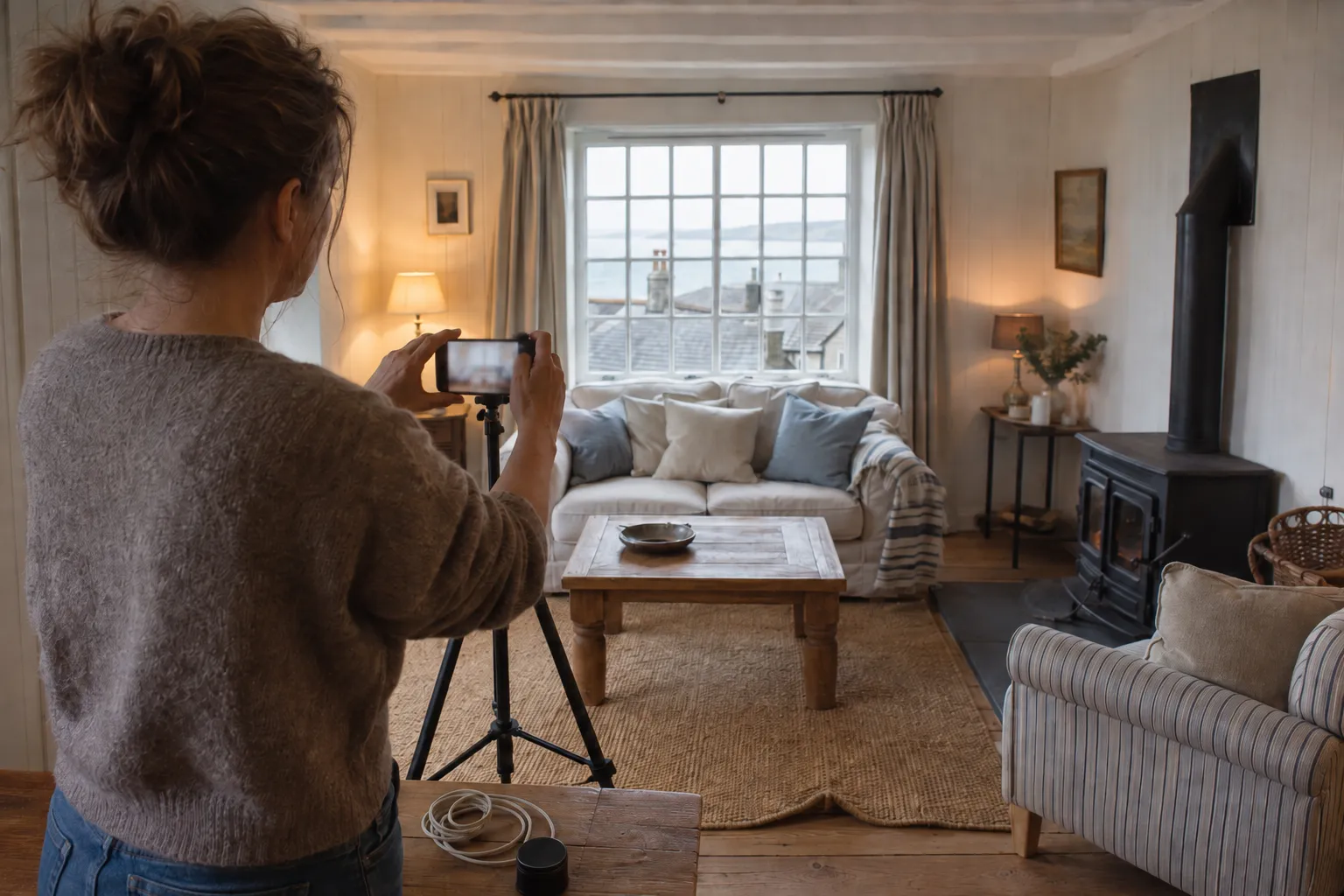
- Directions that start at the road. Which turning, which gate, where the car goes, which of three identical doors is yours. The photography guide sets out how to photograph the whole entry sequence for the arrival guide, step by step.
- Light on the device. A key safe in a dark porch is unreadable at night. A dusk-to-dawn porch light costs little and turns the hardest part of the arrival into the easiest.
- The code in the message, with the steps. Send the code and the sequence together: open the box, take the key, return the key to the box on departure. Put the backup method in the same message, so a flat lock battery costs the guest two minutes and nobody a call at midnight.
- A person on the end of the phone. Somebody still has to answer at any hour, and be able to reach the property if the lock, the key or the guest goes wrong.
The fourth point is where self check-in becomes an operation. You buy the device once. The code changes, the battery checks, the backup key and the answered phone come round every week, for as long as you let the property.
When self check-in is the wrong choice
Self check-in suits most cottages and flats, and three situations argue for a person at the door instead.
- The door cannot be made right. A listed front door where the council has refused a key safe, and no porch or outbuilding to take one, leaves you with a key handover.
- The guests need more than a door code. A property with a tricky boiler, a wood burner or a private water supply benefits from five minutes of walk-through on arrival, and the guide’s point about guests who cannot work a stiff lock applies to more than the lock.
- There is nobody local. If no one can reach the property within the hour when a code fails, the arrival depends on technology with no fallback.
Whichever you choose, the arrival is the first thing a guest experiences and one of the six scores they leave, so it earns its place in the planning alongside price and photographs. If you are working out what your property could earn as a short let, our free valuation looks at the property itself, including how guests will get in and who will be there when they do.
Frequently asked questions
Do I need to change the key safe code after every guest?
Nothing in Airbnb’s rules requires it. A key safe code stays live until you change it, so anyone who has stayed since the last change still knows it. Changing it at each changeover and sending the new code in the 48-hour message keeps access limited to the guest who is booked.
Can I connect any smart lock to Airbnb?
No. Airbnb connects locks from Schlage, Yale and August that join your wifi and have a keypad or touchscreen, and it cannot connect a lock that only has Bluetooth. Any other lock still works for self check-in, but you send the code yourself.
Does a key safe affect my insurance?
It can, depending on the wording of your policy. Read the theft and security conditions in your policy schedule and tell the insurer how guests get in. The insurance guide covers what cover a short let needs in the first place.
Sources
- Airbnb Help Centre: How to check in to your home reservation (the three check-in methods and their descriptions; check-in instructions and self check-in codes sent 48 hours before arrival; read 2026-10-22)
- Airbnb Resource Centre: Connect a smart lock to Airbnb for smoother check-ins (compatible brands; wifi and keypad or touchscreen required; no Bluetooth-only locks; code emailed after booking; activation at check-in and expiry 30 minutes after checkout; backup entry method; updated 13 August 2024; read 2026-10-22)
- Airbnb Help Centre: Restrictions on security cameras and other devices in homes (indoor cameras banned; exterior cameras disclosed; in effect from 30 April 2024; read 2026-10-22)
- Airbnb Help Centre: Guest Favourites (check-in among the category ratings; read 2026-10-22)
- Home Office: Making your small paying guest accommodation safe from fire (exit doors must not need a key to open from the inside; single action handle or lever; England only; updated 20 January 2025; read 2026-10-22)
- legislation.gov.uk: Regulatory Reform (Fire Safety) Order 2005, article 14 (emergency routes and exits; emergency doors not to be locked or fastened so they cannot be easily and immediately opened; read 2026-10-22)
- Scottish Government: Fire safety: existing premises with sleeping accommodation, Annex 2 (paragraph 22, final exit door to open from inside without a key; self-catering up to 10 persons; read 2026-10-22)
- legislation.gov.uk: Planning (Listed Buildings and Conservation Areas) Act 1990, section 7 and section 9 (works affecting a listed building’s character need consent; contravention is an offence; England and Wales; read 2026-10-22)
- legislation.gov.uk: Planning (Listed Buildings and Conservation Areas) (Scotland) Act 1997, section 6 (the Scottish equivalent; read 2026-10-22)
- Scottish Government DPEA: Appeal LBE-230-2043, 1 Upper Bow, Edinburgh (enforcement notice over 11 key safes on the common entrance of a listed building; appeal dismissed 10 April 2019; read 2026-10-22)
- Information Commissioner’s Office: Smart doorbells (commercial use) (DPIA, signage, positioning away from neighbouring entrances; read 2026-10-22)