A photo for an estate agent is selling an asset. A photo for a holiday let is selling an experience: the first coffee at that table, the stove lit after a beach walk. That difference is the whole of Airbnb photography, and it decides who you hire and how you stage every room.
This page is written to be handed over. Send it to whoever is shooting your property, whether that is a photographer or you with a phone and a free morning, and it will tell them what the job is, what to stage before a single frame, and the two shot lists to work through, because there are two. It also covers why the arrival is photographed as carefully as the sitting room, and the platform mechanics at the end, which take an afternoon once the shoot is right.
An asset shoot and an experience shoot are different jobs
An estate agent’s photographer has one question to answer: what am I buying? So they shoot wide, bright and empty. Every room square-on, verticals corrected, maximum floor visible, no belongings, no life. That is the right way to photograph a sale, because a buyer is imagining their own furniture in an empty volume, and the photograph’s job is to describe the volume honestly.
A guest is asking a different question: what will it feel like to wake up here? Nobody books a holiday because the bedroom is 4.2 metres wide. They book because a photograph made them feel the weekend: log basket full, two glasses on the table, a view they can already see themselves ignoring a book in front of. The photograph’s job is to let them try the stay on.
Almost every disappointing set of listing photos we see was shot as an asset: technically clean, evenly lit, wide, empty, and cold. The room is all there and the reason to come is missing. Once you see the two jobs clearly, most of the decisions below make themselves.
Hire the kind of photographer who shoots feelings
This changes who you book, and it is the advice almost nobody gives. A wedding photographer will usually shoot a better Airbnb than an architectural or property photographer, because their whole craft is emotional: light, warmth, anticipation, small human moments, the feeling of a day. An interiors photographer from the property world will give you perfectly corrected verticals in rooms with nobody in the frame and nothing on the boil. Beautiful, and it sells the asset.
You are not obliged to hire either. But when you do look for one, judge the portfolio on one test: does their work make you want to be in it? Wedding, lifestyle, food and documentary photographers pass that test constantly. If their portfolio makes you feel the morning, they can shoot your cottage. If it makes you admire the cornicing, keep looking.
Whoever shoots it, the rest of this page is their brief.
Airbnb photography that sells the experience
Concrete craft, because “evoke emotion” is useless direction on its own.
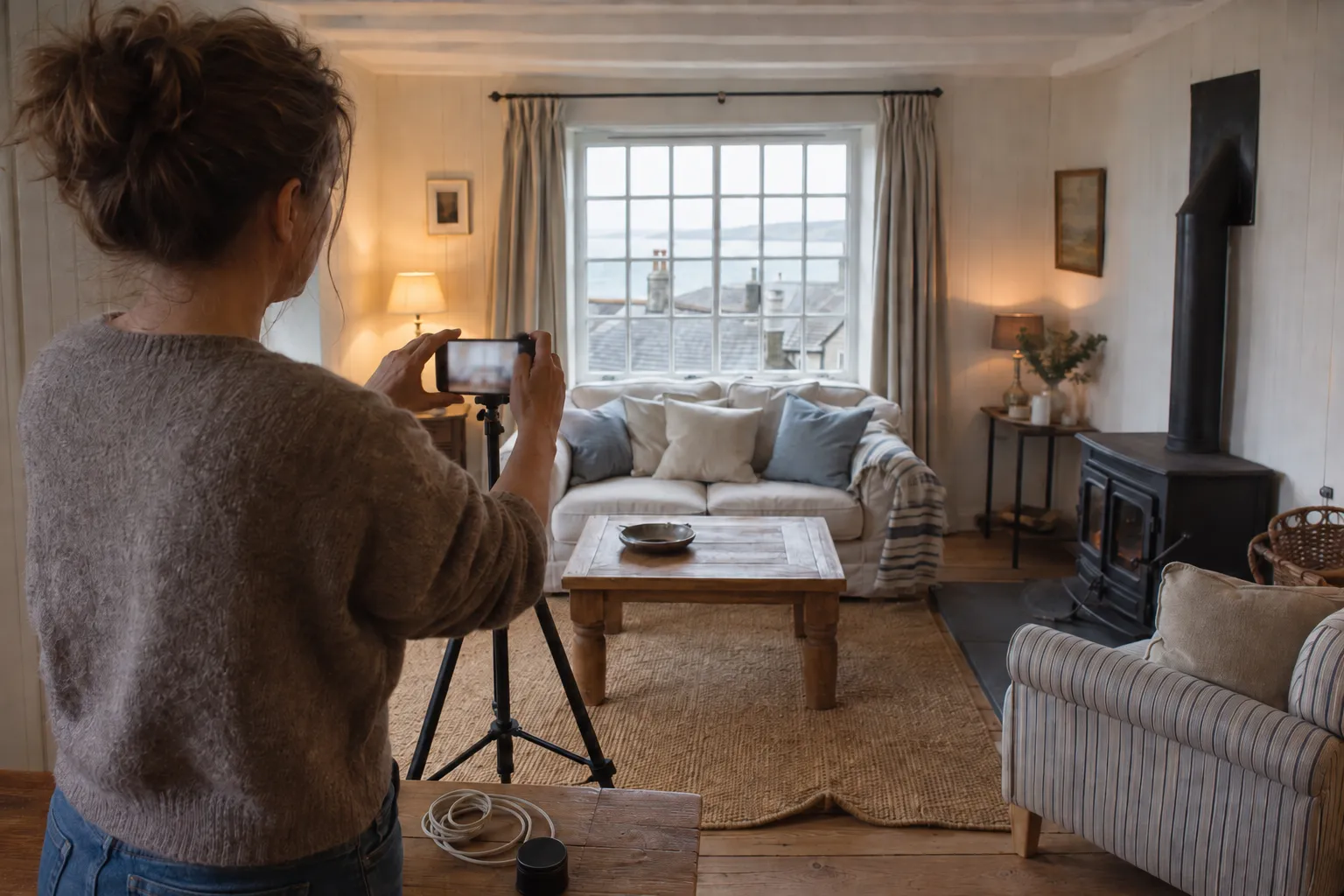
- Shoot moments a guest can step into. The table laid for breakfast. The stove lit. A dressing gown on the bathroom door. The paperback face-down on the arm of the chair. Each one is an invitation to imagine yourself mid-stay, and imagination is what books.
- Let the light be the subject. Shoot the sitting room when the evening sun actually hits it, and the bedroom in soft morning light, even if that means two visits. Warm lamps on everywhere, always. An estate agent shoots at noon for evenness; you are shooting for atmosphere, and atmosphere lives at the edges of the day.
- Depth beats width. The widest lens flattens a room into a floor plan. Shooting through a doorway, past the flowers, over the back of the sofa gives the frame foreground and pulls the viewer inside it. Some of your best frames should deliberately show less of the room.
- Photograph the senses you cannot photograph. Steam off a mug. Rain on the window with the lamp on. Bare feet height rugs, thrown blankets, an open fire. A cold bottle and two glasses. The eye reads temperature, smell and sound out of pictures that stage them.
- Shoot the property’s one unrepeatable thing hardest. The sea from the bed, the bath under the skylight, the garden gate straight onto the coast path. Whatever a guest cannot get at the hotel gets the most frames, the best light and first place in the listing.
- Details are memory anchors. The brass key on its fob, shells on the windowsill, the enamel teapot. Close-ups punctuate a listing the way they punctuate a wedding album, and they are what guests remember the property by afterwards.
One honesty line, and it matters: stage the experience, never the evidence. Flowers, fruit and firewood are set dressing, and fine. Anything that fakes proof, a full calendar, invented reviews, a “sea view” leaning out of a landing window, breaks trust and the rules the platform and the law set in the worst case. Sell the feeling of what is genuinely there.
Stage every room before a single frame
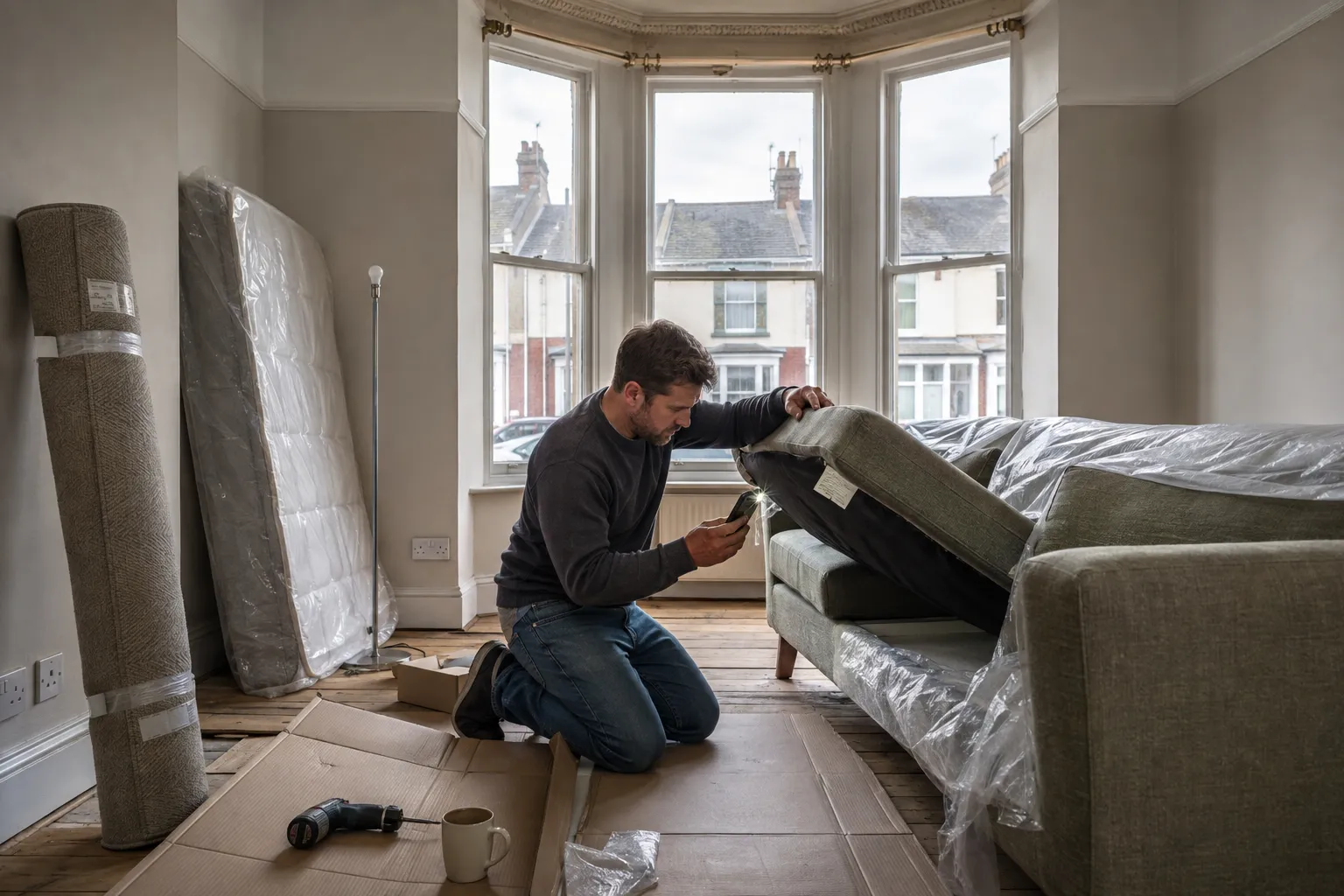
Every property gets staged for its shoot. Staging here means the small set dressing that makes a room look mid-stay, and it costs a supermarket run:
- Kitchen and table: flowers in a jug, a bowl of real fruit, the table laid for two, a cafetiere and cups out, a loaf on the board. Clear the draining rack, hide the tea towels with slogans, bin the washing-up liquid.
- Sitting room: stove or fire lit, throws draped with intent, cushions plumped and varied, a book or the property’s guest folder open, lamps on, television off and screen clean.
- Bedrooms: beds made with the linen ironed and the duvet pulled drum-tight, layered with a runner or throw, both bedside lamps on, water carafe and glasses out, nothing stored under the bed in shot.
- Bathroom: towels rolled or hung in matched sets, a plant or flowers, toiletries in matching bottles, loo lid down, bath mat straight, mirror polished after the room has cooled.
- Outside: the table set for coffee or a glass of wine, cushions on the outdoor chairs, the barbecue lid closed, bins and hoses out of frame, the doormat straightened.
- Everywhere: cables, chargers, air fresheners, notices and anything laminated out of sight. Signs of life are the point; signs of admin are not part of the experience.
If the property is not yet furnished to this standard, stage the shoot after the kit list is complete: the room-by-room furnishing checklist is the shopping list, and the shoot is its reward.
Shoot the whole arrival, from the car to the kitchen table
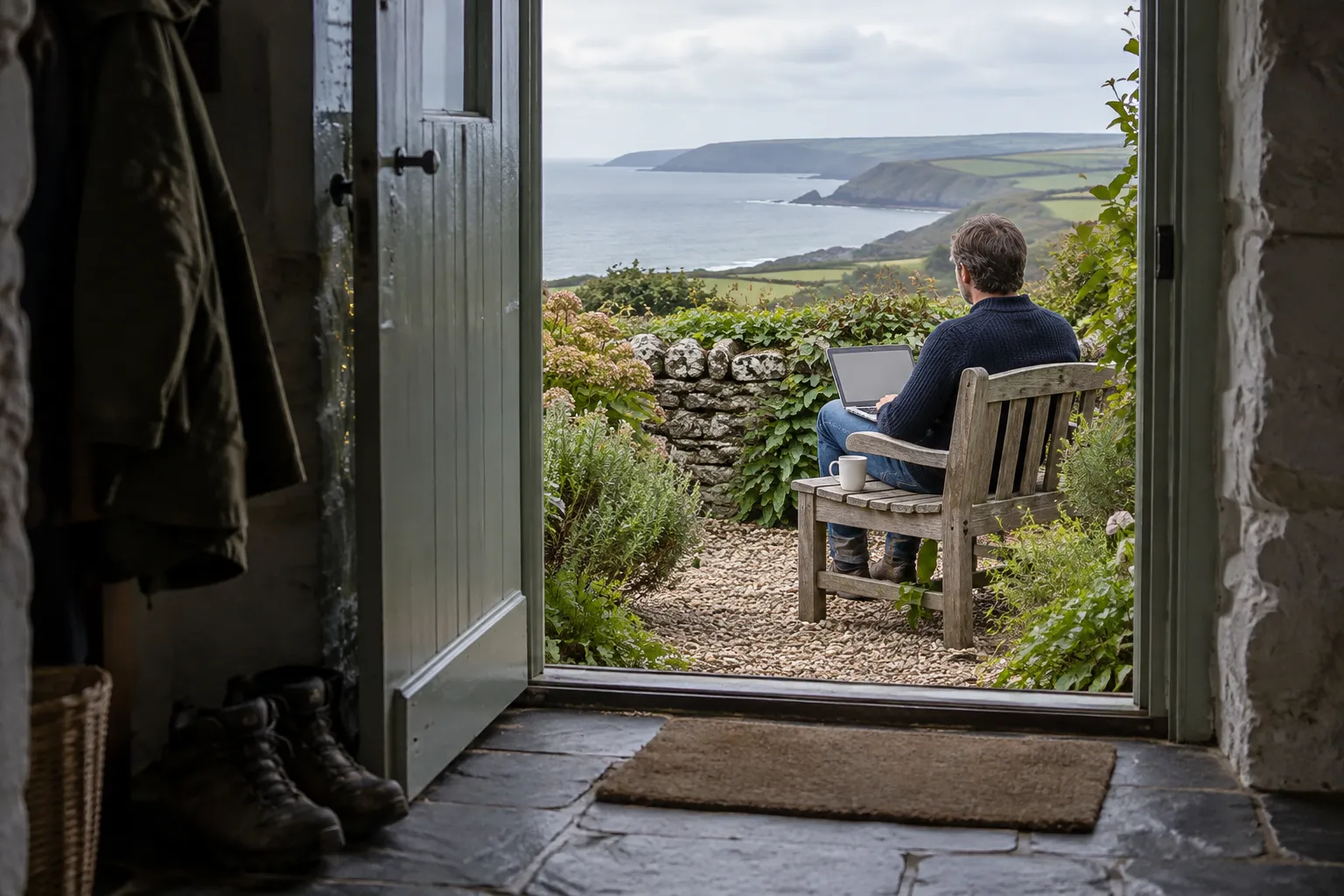
Here is the tip that pays for the whole shoot day, and it is one we use ourselves: photograph the entire check-in experience, step by step, exactly as a guest lives it. Start before the property does. The turning off the lane. The parking space with a car actually in it. The walk from the car with bags. The gate, the path, the key safe or the key handover. The front door opening. The hallway with the lights on. The folder, the wifi card and the welcome basket on the kitchen table.
These frames do two different jobs, and it helps to name them.
ONE WALK, TWO SHOT LISTS
The arrival, shot twice
The parking space
Shot at dusk with a car actually in it and the porch light beyond. Arrival confidence in one frame.
Straight-on from the road, so a guest can match it from the driver's seat. Caption it with the space number or location.
The walk to the door
The bags-in-hand view down the path, flowers out, gate open.
Every turning point on the path in order, for the pre-arrival message.
The key
The key on its fob on the hall table, one of the listing's detail close-ups.
The key safe straight-on at eye level, framed with enough context to find it.
The door opens
The door ajar onto a lit hallway. The most inviting single frame of the arrival.
The lock's knack, photographed mid-action if it has one.
The hallway
Warm and lamp-lit, coats and boots staged, the house saying come in.
Light switches, thermostat and heating controls, straight-on and captionable.
The kitchen table
Welcome basket, flowers and the folder laid out. The stay begins here.
The wifi card beside the router, and the folder open at its contents page.
These go in the listing. Arrival is part of the experience, and an easy one photographs beautifully.
These go in the guest guide, the pre-arrival messages and the guest pack. Shot straight-on and boring on purpose, because they are instructions.
The front-of-house frames go in the listing, because arrival is part of the experience you are selling and an easy arrival photographs beautifully: a lit porch at dusk does more for booking confidence than three more sofa angles. The back-of-house frames go in your guest guide, your pre-arrival messages and your guest pack: the key safe photographed straight-on, the parking space from the road, the fuse board behind its cupboard door, the stopcock, the bin store on collection morning. Guests stop asking where things are when the answer is a photograph, and the shoot is the one morning somebody is already there with a camera and good light.
Thinking of the whole experience makes this automatic. Walk the property once as a guest, from the car to the kettle, photographing every decision point. You will come back with both lists filled.
The two shot lists
List one: the frames that sell the stay. Work through it in guest order.
- The hero moment. The property’s one unrepeatable thing, staged, in its best light. This is the frame that earns the click, and the search card it appears on is a different battle from the listing page.
- The arrival, front of house. The approach, the porch lit, the door open onto a warm hallway.
- The sitting room as a moment. Fire lit, lamps on, one wide frame for orientation and two closer frames with foreground.
- The kitchen twice. One wide, one lifestyle frame at the staged table.
- Every bedroom, staged, whole bed in frame, shot from the corner that gives depth.
- Every bathroom, towels staged, including the one you like least.
- Outside space in use, table set, and the view from it.
- The details. Six to ten close-ups: keys, flowers, fruit bowl, books, the teapot, the log basket.
List two: the frames that run the stay. Straight-on, evenly lit, captionable: parking, key safe, entry sequence, heating controls, hob and oven controls, wifi router and card, bin store and collection point, stopcock and fuse board, anything with a knack to it. Shoot them boring on purpose; these are instructions.
What Airbnb does with the photos afterwards
The platform mechanics still decide how the work is displayed, so finish the job properly.
Airbnb organises listing photos into a photo tour: photos are sorted into rooms automatically, in Airbnb’s words “new photos are automatically sorted into rooms by our AI engine”, and you can then move, add or remove them. Every room or space needs at least one photo “so it can appear in your photo tour”, and a room with none can be removed from the tour. After any upload, open the tour, move what landed in the wrong room, and check nothing is missing.
TICK WHAT YOU ACTUALLY HAVE
Your photo tour, room by room
Every tile left unticked is a room a guest cannot see. Airbnb asks that every room or space has at least one photo so it can appear in the tour, and where a room has none the options are to add photos or take the room out of the tour altogether.
The technical bar is low and worth stating exactly, because the numbers circulating on other guides do not come from Airbnb. The only published size requirement is at least 1024 by 683 pixels, “when in doubt, a bigger photo is better”, and there is no required photo count. Shoot in landscape: Airbnb states that search results display photos in landscape, and a portrait frame gives up most of itself.
SWITCH THE SHAPE YOU SHOT IN
What survives a landscape crop
SHOWN IN SEARCH
Shot at 3:2 landscape. The whole frame survives, and you chose what is in it. This is the shape to shoot in.
SHOWN IN SEARCH
Shot square. Roughly a third of the height is cropped away, taken off the top and bottom, which is usually the ceiling and the floor you framed deliberately.
SHOWN IN SEARCH
Shot portrait. Most of the picture never appears. Airbnb says vertical photos will not showcase a space as well, and this is why.
Schematic. The teal band is the part of your original that a landscape search result has room for.
These photographs are also the ones every other booking site will use if you ever distribute beyond Airbnb, and each site crops and orders them its own way. That is one more argument for shooting landscape and shooting the whole arrival: see listing on multiple booking sites for what going wider actually involves.
The brief, on one screen
If you send your photographer nothing else, send this.
The job: this is experience photography, closer to a wedding morning than a property shoot. Every frame should make someone want the stay. Before shooting: the property will be staged: flowers, fruit, fires lit, beds drum-tight, lamps on everywhere. Walk it once as a guest first. Shoot: the hero feature hardest and in the best light; every room staged with depth and foreground; the full arrival from parking to kitchen table; six to ten detail close-ups; then the plain instructional set: keys, controls, parking, bins, straight-on. Format: landscape, largest files you have; anything over 1024 by 683 pixels satisfies the platform. Do not: shoot rooms empty and wide like a sale listing, use portrait for anything intended for the listing, or stage anything that fakes what the property has.
If you want to know what the property would realistically earn once it is presented like this, get a free Airbnb valuation. Presentation is a large part of what marketing-led management does, and the assumptions behind the numbers are stated.
Frequently asked questions
Should I use an estate agent’s photographer for my Airbnb?
Usually no, and it is worth understanding why before you book anyone. Estate agency photography is built to sell an asset: wide, even, empty and square-on, so a buyer can judge the space. A holiday let sells a stay, and the craft that captures a stay is the wedding and lifestyle photographer’s: light, moments, food, small human details. If a property photographer is who you have, send them this page and ask them to shoot the staged, lamp-lit version of the house.
What does staging an Airbnb for photos actually mean?
Set dressing, done in an hour before the shoot: flowers on the table, fruit in the bowl, the table laid, fires lit, lamps on, beds made drum-tight, towels rolled, cables and notices hidden. The aim is a property that looks mid-stay. It is honest as long as everything staged is genuinely available to guests; the line to stay behind is staging evidence, like views a guest cannot actually see from the property.
How many photos does an Airbnb listing need?
Airbnb does not publish a required number, and the “20 to 30 photos” figure that circulates is not theirs. The rule that does come from Airbnb is coverage: every room or space needs at least one photo to appear in your photo tour. Count rooms first, then add the experience frames and details. Most well-photographed listings land between two and four frames per room plus the arrival and the close-ups.
Why are some of my photos in the wrong room?
Because the sorting is automatic. Airbnb assigns new photos to rooms with an AI engine, and it works from what it sees, so a bedroom shot taken from the landing can land in the wrong place. Open the photo tour after any upload, move anything that has gone astray, and check every room still has at least one photo.
Sources
- Airbnb Help Centre: Taking great photos of your listing (the 1024 by 683 minimum, landscape display in search, and the preparation and composition guidance; article 746, checked 2026-08-12)
- Airbnb Help Centre: Setting up a photo tour for your home listing (the photo tour, AI room sorting, the requirement that every room has at least one photo, and removing a room without photos; article 477, checked 2026-08-12)