A holiday let with any gas appliance needs a safety check by a Gas Safe registered engineer every 12 months, and a written record of each check. The duty sits in regulation 36 of the Gas Safety (Installation and Use) Regulations 1998 and covers England, Wales and Scotland. Where guests stay 28 nights or fewer, you can display one copy of the record prominently in the property instead of handing it to every guest.
That display provision is what makes the duty workable for a property with new guests every few nights, and it is set out in full below.
Why a holiday let counts as rented accommodation
A holiday let counts because regulation 36 covers premises occupied for residential purposes, for money, under a lease or a licence. A guest booking a cottage for a week occupies it under a licence, so the owner is the licensor and takes on the landlord’s duties.
The Health and Safety Executive removes any doubt. Its landlord guidance lists the accommodation the duties reach, and the list includes “rented holiday accommodation such as chalets, cottages, flats, caravans and narrow boats on inland waterways”. Bed and breakfasts and hotels are on it too.
The same duty covers a property on mains gas and one running on bottled or tank LPG. What matters is whether there is a gas appliance or gas pipework there, and who provided it.
One detail of language is worth knowing before you speak to an engineer. The regulations never use the word certificate. They require a record of each check. “Gas safety certificate” and “CP12” are the names the trade and owners use for that record, and they all mean the same document.
What the gas safety check covers
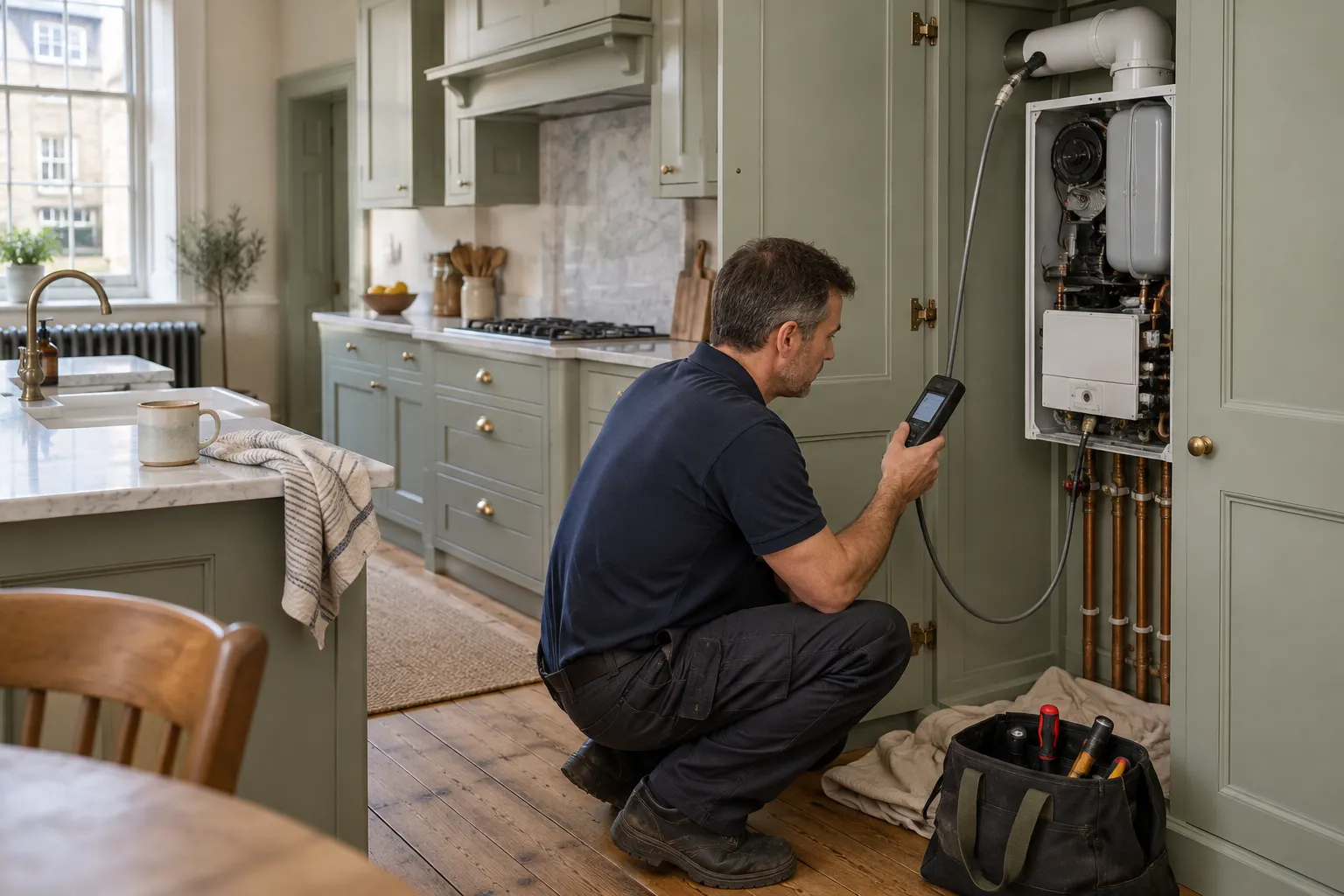
The annual check covers every gas appliance and flue you provide for guests. That means the boiler, a gas hob or cooker, a gas fire, and any flue serving them. Separately, regulation 36(2) requires you to keep all of those, and the pipework, in a safe condition at all times, which is a continuous duty that the annual check evidences.
Regulation 36(9) sets the minimum content of the check by pointing to regulation 26(9). The engineer must examine:
- the effectiveness of any flue
- the supply of combustion air
- the appliance’s operating pressure or heat input, or its combustion performance where measuring those is not reasonably practicable
- its operation, to make sure it functions safely
An appliance a guest brings with them sits outside your duty, because the regulation excludes appliances the occupier is entitled to remove. HSE adds that it is good practice to include every flue and chimney connected to a gas appliance in the check, even one you did not provide.
The safety check is the legal minimum, and it is the visit that produces the record. HSE says that although no timeframe is prescribed for maintenance, good practice is to show regular annual maintenance as well, so book the boiler service and the safety check as one visit and ask for both by name.
How often a holiday let needs a gas safety check
Every 12 months. Regulation 36(3)(a) requires each appliance and flue to be checked within 12 months of installation, then at intervals of not more than 12 months since the last check.
Since April 2018 you have a two-month window that keeps your date. Under regulation 36A(1), a check completed in the two months ending on the deadline counts as if it had been done on the deadline itself. Book the engineer ten months after the last visit and your anniversary stays exactly where it was.
Regulation 36A, Gas Safety (Installation and Use) Regulations 1998
Months 11 and 12 keep the anniversary where it is
Fourteen months after a gas safety check, one block per month. The deadline is the end of month 12.
- Months 1 to 10. A check is valid, and the next 12 months run from the day it was done. Use this to move the anniversary on purpose.
- Months 11 and 12. The check is treated as made on the deadline date, so the next one is due exactly a year after the old anniversary.
- Months 13 and 14. Overdue. The one exception is a single use per appliance, and only to bring its date into line with another appliance in the same property.
Regulation 36A(2) and (3) add a narrow second option. You may have an appliance checked in the two months after its deadline, but only once per appliance, and only to line its date up with the next check of another appliance in the same property. It exists for the house where the boiler and the gas fire went in at different times, and it can be used once.
Put the anniversary in your quietest month
The two-month window solves a problem every busy holiday let has: the engineer needs access, and the property is booked. A check carried out early, before the window opens, is perfectly valid and simply restarts the 12 months from that day. So you can move the anniversary once, deliberately, into the weeks your calendar is emptiest, and use the two-month window every year after to slot the visit into a changeover.
The cost of getting this wrong runs the other way. An anniversary that lands in the summer holidays forces a choice between blocking a peak night and running a check late, and late is an offence. Choosing the date is a small piece of the same planning that decides when you price up and when you open long-stay discounts.
What the gas safety record must say
The record must contain nine things, set out in regulation 36(3)(c). Check your engineer’s paperwork against them, because a record missing one of them is an incomplete record:
- the date of the check
- the address of the property
- the name and address of the landlord, or the agent where appropriate
- a description and the location of each appliance or flue checked
- any safety defect identified
- any remedial action taken
- confirmation that the check met the regulation 26(9) examination
- the name and signature of the engineer
- the Gas Safe registration number of the engineer or their employer
Keep each record until two further checks have been made on that appliance or flue, which in practice means holding the last three. For an appliance you remove, keep its last record for two years from the date of its final check. Regulation 36(5) also entitles anyone lawfully staying in the property to inspect the record on request.
Do you have to display the gas safety record?
For short stays, displaying it is the practical answer and the regulation allows it. Regulation 36(6)(b) requires a copy of the latest record to be given to each new occupier before they move in, then adds that where the right to occupy is for a period not exceeding 28 days, “a copy of the record may instead be prominently displayed within those premises”.
A copy in a clear plastic sleeve inside the kitchen cupboard door or with the house manual meets it, as long as a guest would actually see it.
Regulation 36(6), Gas Safety (Installation and Use) Regulations 1998
The length of the stay decides how the guest gets the record
Booking length in nights, drawn to scale. Night 28 is the line the regulation draws.
Up to 28 nights
Display one copy prominently in the property
Covers a typical holiday booking. No need to send each guest their own.
Over 28 nights
Give the guest a copy before they arrive
A contractor or relocation stay. Email it with the booking confirmation.
Someone staying when the check is done must be given a copy within 28 days of the check, whatever the length of their booking.
A stay of more than 28 nights changes the paperwork. Those guests must each be given a copy before they occupy the property, which is easiest to do by attaching it to the booking confirmation. If you take mid-term lets, build that into the booking process now, because it is the step a short-stay routine will miss.
Who is responsible for gas safety in a holiday let
The owner, in almost every arrangement. The duty falls on the landlord as regulation 36 defines it, which for a holiday let is the person granting the guest their licence to stay, and HSE is clear that a landlord cannot hand the duty to the occupier.
Three arrangements are worth checking against your own.
- A management company. HSE says the management contract should state clearly who arranges maintenance and safety checks. Where the contract gives the agent that job, the agent takes on the same duties as a landlord. HSE still advises owners to ask for copies of the records, and you should, because the property is yours. Your management agreement is the place this allocation belongs.
- Rent to rent. Where the person granting the guest’s licence is themselves a tenant of the property, the regulation looks past them to the owner. HSE puts it directly: licensors who are themselves tenants “are not regarded as landlords in this context”. If you have let your property to an operator who sublets it to holidaymakers, the gas duty stays with you, which is one more reason to read the arrangement carefully.
- A flat with a communal boiler. Appliances and flues that serve your flat from elsewhere in the building can fall within the duty. HSE says your arrangements with the building owner should make sure communal gas appliances are maintained and checked, and that you can see the evidence.
Gas appliances in bedrooms and bathrooms
A gas appliance in a room used for sleeping needs particular care, and it is the trap in a conversion. Regulation 36(11) requires the landlord to make sure no gas fitting is fitted in a guest bedroom of a type regulation 30 would prohibit installing there.
Regulation 30 bans a gas fire, space heater or water heater over 14 kilowatts gross heat input in a bedroom unless it is room-sealed. At 14 kilowatts or less, it must be room-sealed or have a safety control that shuts it down before combustion products build up. Any gas appliance in a bathroom or shower room must be room-sealed. The rules reach a cupboard inside the room, and one next to it with an air vent into it.
The sting is in regulation 36(12). Its exemption covers only rooms used as bedrooms since before the regulations came into force on 3 October 1998, so a room converted into a bedroom today gets no protection from it. Turn the snug with the old gas fire into a fourth bedroom to lift the nightly rate and the fire may have to go. Ask the engineer before the beds arrive.
Scotland adds a licence condition
In Scotland the same regulation 36 applies, and the short-term let licence adds two conditions of its own. Paragraph 5 of Schedule 3 to the Scottish licensing order requires an annual gas safety inspection of all gas pipes, flues and appliances, and says that if an appliance fails, the property must not be let until the work to bring it up to standard is done.
Paragraph 12 then requires a copy of the gas safety report to be available within the premises, somewhere all guests can reach it, together with instructions on what to do if the carbon monoxide alarm sounds. In Scotland, the displayed copy is a licence condition in its own right. The rules guide sets out what else each nation’s licensing or registration scheme asks for.
Northern Ireland has separate gas safety regulations of its own and sits outside this article.
What happens if you skip the gas safety check
Breaching the gas safety regulations is a criminal offence. Section 33(1)(c) of the Health and Safety at Work etc. Act 1974 makes it an offence to contravene any health and safety regulations, and the 1998 regulations are made under that Act.
The record is also the evidence that travels. A Scottish licence requires a copy in the property, and England’s coming registration scheme is expected to care about the same safety paperwork. Penalties depend on the court and the offence, so this article does not quote figures.
How gas fits with the rest of your safety paperwork
Gas sits alongside the other safety jobs a holiday let carries from the first paying night. The fire risk assessment must be written down, and it is where carbon monoxide alarms are decided, with one expected wherever there is a gas or solid fuel appliance. The furnishing checklist covers the alarms and the furniture labels room by room. The compliance checklist keeps the due dates for all of them in one place for each property you let.
A property that is booked solidly is the one where a lapsed gas date does the most damage, because there is never an empty week to fix it in. If you are weighing up what your home could earn as a holiday let, our free valuation comes back with the compliance jobs flagged for your property, and the calendar that has to fit around them.
Frequently asked questions
Does my holiday let need a gas safety check if it only has a gas hob?
Yes. Regulation 36 covers every gas appliance you provide for guests, with no minimum size, so a hob on its own needs the annual check and a record. The installation pipework serving it must be kept safe as well.
Does a static caravan or lodge on LPG need a gas safety check?
Yes, if you let it to paying guests. HSE lists caravans among the rented holiday accommodation the landlord duties cover, and the regulations apply to LPG as well as mains gas. Check what your holiday park’s own terms require too, because a park can set conditions of its own.
Is a boiler service the same as a gas safety check?
Only if the engineer also carries out the regulation 36 safety check and gives you the record. The check is the legal minimum. HSE treats regular annual maintenance as good practice on top, and one Gas Safe engineer can do both on the same visit if you ask for both when you book.
How long do I keep old gas safety records?
Until two further checks have been made on that appliance or flue, so in practice you hold the last three. For an appliance that has been removed, keep its final record for two years from the date of the last check.
Sources
- legislation.gov.uk: Gas Safety (Installation and Use) Regulations 1998, regulation 36 (definitions of landlord, licence and relevant premises; the 12-month check; the nine-item record and retention; the 28-day display provision in 36(6)(b); bedrooms in 36(11) and (12); extent England, Wales and Scotland; read 2026-10-21)
- legislation.gov.uk: Gas Safety (Installation and Use) Regulations 1998, regulation 36A (the two-month window and the one-off alignment option, inserted 6 April 2018 by S.I. 2018/139; read 2026-10-21)
- legislation.gov.uk: Gas Safety (Installation and Use) Regulations 1998, regulation 26 (paragraph (9), the matters the check must examine; read 2026-10-21)
- legislation.gov.uk: Gas Safety (Installation and Use) Regulations 1998, regulation 30 (room-sealed and 14 kilowatt rules for bedrooms and bathrooms; read 2026-10-21)
- HSE: Gas safety, landlords and letting agents (rented holiday accommodation covered; agents; sub-letting; communal appliances; tenants’ own appliances; read 2026-10-21)
- legislation.gov.uk: Civic Government (Scotland) Act 1982 (Licensing of Short-term Lets) Order 2022, Schedule 3 (paragraph 5 gas safety; paragraph 12 information available to guests, as amended by S.S.I. 2024/227; read 2026-10-21)
- legislation.gov.uk: Health and Safety at Work etc. Act 1974, section 33 (offence of contravening health and safety regulations; read 2026-10-21)
- GOV.UK: Letting out a self-catering holiday home in England: rules and regulations (directs owners to the HSE gas guidance; last updated 2 October 2026; read 2026-10-21)