Usually not in England, where there is no planning use class for short lets. Permission is needed only where letting the property amounts to a material change of use, which is a question of fact and degree decided by your council. Wales has had its own use classes since 2022, and parts of Scotland require permission outright.
The rest of this page is how each nation reaches that answer, what tips a property over the line, and the application that turns “probably fine” into a decision the council is bound by.
England: no use class, so it turns on material change of use
England has no planning category that says “short-term let”. A dwelling is a dwelling, and the question is whether letting it to paying guests changes its use so much that the change itself needs permission.
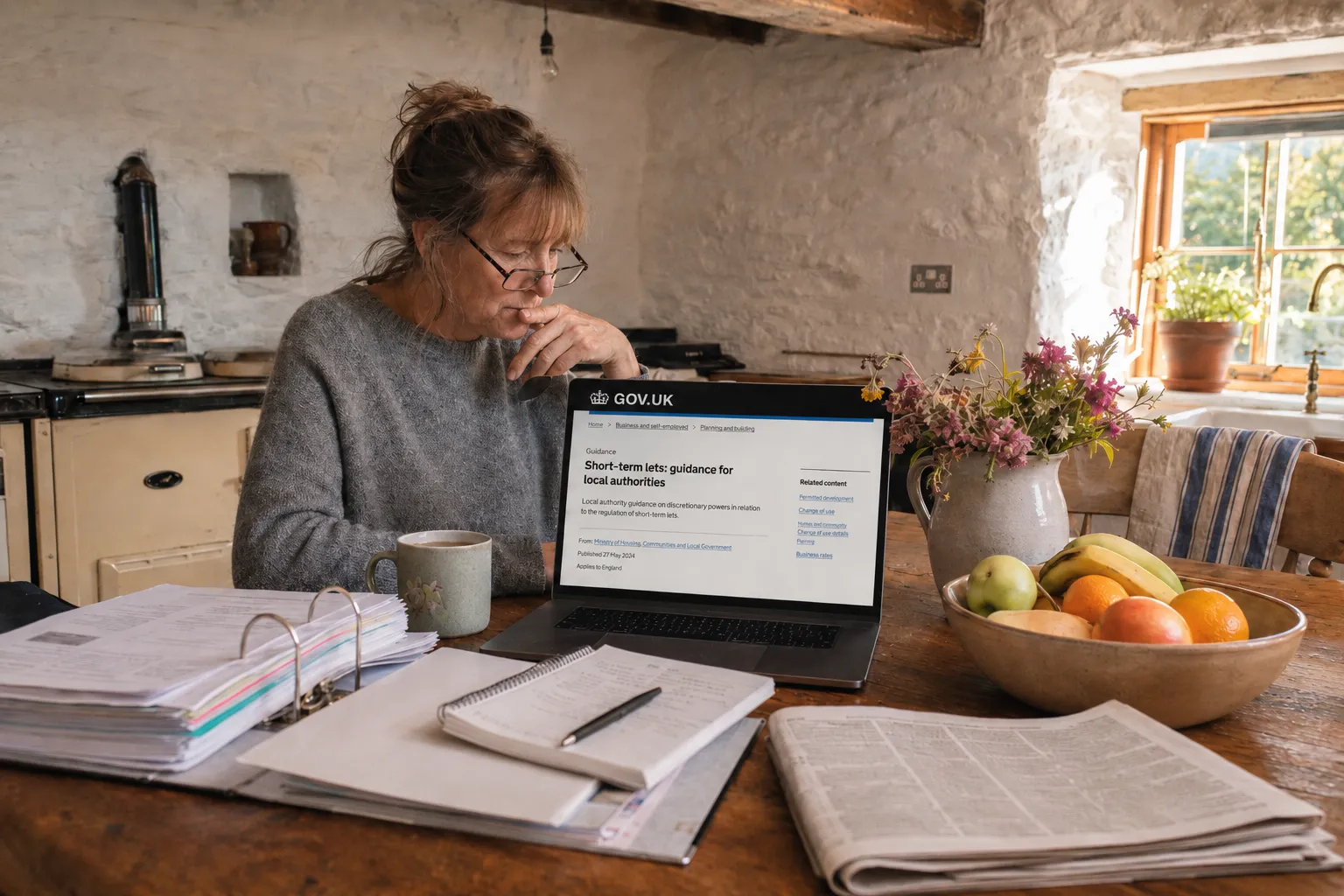
Government planning guidance is unusually direct about this. There is no statutory definition of a material change of use, and the guidance says the concept is “linked to the significance of a change and the resulting impact on the use of land and buildings”. It then sets the standard that decides your case: “Whether a material change of use has taken place is a matter of fact and degree and this will be determined on the individual merits of a case.”
The same guidance addresses short-term letting head on. Outside Greater London, letting a property short term generally does not require planning permission where there is no material change of use. Where there is one, enforcement action remains possible.
So the useful question is not “does an Airbnb need permission”. It is “what would make mine a material change”.
The factors councils weigh are the ones a neighbour would notice:
- How often, and how many. A property let most weekends of the year to changing groups reads differently from one let three times a summer.
- Whether anyone lives there. Letting a room in your own home while you are in it is at the far end of the scale from a whole house run as a commercial operation.
- The character of the coming and going. Late arrivals, suitcases at midnight, taxis, parties, bins out on the wrong day. Planning is about the use of land, and disturbance is evidence of a different use.
- Parking and shared access. Especially on a narrow lane or a shared drive, where turnover is visible and constant.
- How it presents commercially. Signage, a dedicated entrance, a key safe wall, a property that is plainly a business rather than a home.
None of those is a threshold. Together they are the picture your council would form if someone complained.
Where the property is decides which question you are answering
Four routes to the same answer
England, outside London
Permission only if letting is a material change of use. Fact and degree, decided case by case.
Greater London
Up to 90 nights a calendar year without permission, where the property is liable for council tax. Beyond that, permission.
Wales
Use classes C3, C5 and C6 exist. Movement between them is usually permitted development, unless an Article 4 direction removes it.
Scotland
Inside a designated control area, change of use to secondary letting always needs permission. Outside one, the ordinary test applies.
London is the one place with a number
Greater London has a statutory limit rather than a judgement call: a property may be let for up to 90 nights in a calendar year without planning permission, provided it is liable for council tax. Go beyond 90 and you need permission for the change of use.
It applies to the 32 boroughs and the City of London, and nowhere else. The rules by nation sets out how the cap works and what enforcement looks like.
Wales decided it with use classes
Wales stopped relying on judgement in September 2022 and wrote short lets into the use classes themselves. Since 20 September 2022 there have been three residential classes rather than one:
- C3, a dwellinghouse used as a sole or main residence.
- C5, a dwellinghouse used otherwise than as a sole or main residence, occupied for 183 days or fewer in a calendar year.
- C6, short-term letting, where each period of occupation is not longer than 31 days.
Moving between C3, C5 and C6 is generally permitted development, so in most of Wales the change itself does not need an application. The sting is in the second instrument: a council can remove that permitted development right locally with an Article 4 direction, and then the same move needs full permission.
Eryri National Park is the example to look at. Its direction came into force on 1 June 2025 and requires planning permission before changing a property from a main residence to a second home or a short-term holiday let, or from a second home to a short-term let. It is not retrospective: properties already in that use before 1 June 2025 are unaffected.
Two details catch people out. C5 is defined by days of occupation, not by whether you let it. And a booking longer than 31 nights falls outside C6, which matters if you take winter contractor stays.
Scotland: control areas make it automatic
Scotland gave planning authorities a power England does not have. Under section 26B of its planning act, an authority can designate all or part of its area as a short-term let control area. Inside one, a change of use of a dwellinghouse to secondary letting is deemed a material change and therefore always requires planning permission, subject to the exceptions in the regulations.
Two are in force. One covers the entire City of Edinburgh Council area; the other covers Badenoch and Strathspey, in the Highland Council area. Outside a control area, Scotland applies the ordinary material change of use test. Authorities have to publicise a new control area before it takes effect, so check your own council rather than assuming the list is still two.
Licensing is a separate regime and applies across Scotland whether or not you are in a control area. The rules by nation covers the licence; this page covers the permission.
England’s proposed use class is not law, and it is not the register
The government has said it will introduce a use class for short-term lets in England, with permitted development rights to move in and out of it, and flexibility for people letting their own main home for up to 90 nights a year. As at this check it remains a proposal. The guidance that describes it is written in the future tense, and the use classes order still has no C5 in England.
Two things follow. Pages that describe England’s C5 as if it already governs your property are wrong, and the proposal is a separate measure from the national registration scheme. What is actually confirmed about the England register tracks that one.
If you need certainty, there is a form for that
The unsatisfying part of “fact and degree” is that nobody can tell you the answer over the phone, and your council’s planning officer will be careful not to give an informal ruling you could rely on.
There is a formal route: a certificate of lawful development. Under sections 191 and 192 of the Town and Country Planning Act 1990 you can ask your local planning authority to decide whether an existing use is lawful, or whether a proposed use would be lawful. The decision binds the council in a way a conversation does not.
It is worth the application fee in three situations in particular:
- You are buying a property to let and the numbers only work as a short let.
- A neighbour has complained, or the council has written to you.
- You are refinancing or selling, and a buyer’s solicitor wants the use confirmed.
Your council publishes its own fee and determination period. Apply with evidence: booking records, dates of occupation, how the property has been used and for how long.
When permission is the least of your problems
Planning is one permission among several, and it is often not the one that stops a property.
- Your lease. A flat’s lease can prohibit short letting outright, whatever the council thinks. Running an Airbnb from a leasehold flat sets out the covenants that decide it.
- Your lender. A residential mortgage generally does not permit commercial short letting without consent. What your mortgage actually requires covers the three categories and what consent involves.
- Your insurer. Standard home insurance does not cover paying guests.
- Your freeholder or management company, where a block has its own rules.
Any one of those can be the reason a property never lets, and none of them is fixed by a planning certificate.
Where this leaves you
For most properties in England the use has not changed enough to need permission, and the risk concentrates on lettings run at real commercial intensity in places where neighbours notice. Where it is genuinely uncertain, a certificate settles it in a way a phone call never will.
Whether the property is worth letting at all is the separate question, and it turns on what it would earn against what running it costs. That is what a free Airbnb valuation is for: a realistic range with the assumptions shown, before you spend anything. If the numbers work and you would rather not run it yourself, full management is how we take it on.
Frequently asked questions
Do I need planning permission to let a spare room in my own home?
Almost never. Letting a room while you continue to live in the property sits at the far end of the fact and degree scale, and the use of the building has not meaningfully changed. In Greater London the 90-night cap applies to the property, so keep a count if you let often.
Does it make a difference that I only let in the summer?
It can. Frequency and intensity are among the things a council weighs, so a property let for a few summer weeks looks different from one let most of the year to changing groups. Seasonal use is not a safe harbour, though: there is no number of nights in England outside London that makes the answer automatic.
How do I get a definite answer for my property?
Apply to your local planning authority for a certificate of lawful development, under section 191 for a use that already exists or section 192 for one you are planning. The council’s decision is binding, which an informal conversation is not.
What happens if the council decides I needed permission?
It can take enforcement action, and the practical consequence is usually a requirement to stop the use or to apply for permission retrospectively. Councils vary in how they approach it, and the outcome turns on the facts of your property, so this is a point to take to a planning consultant or solicitor rather than a forum.
Sources
- GOV.UK planning guidance: When is permission required? (material change of use, the fact and degree test, short-term letting, London’s 90 nights, certificates of lawful development; checked 2026-09-29)
- The Town and Country Planning (Use Classes) (Amendment) (Wales) Order 2022 (Classes C5 and C6, in force 20 September 2022; checked 2026-09-29)
- The Town and Country Planning (General Permitted Development etc.) (Amendment) (Wales) Order 2022 (permitted movement between C3, C5 and C6; checked 2026-09-29)
- Welsh Government: Changes to planning legislation and policy for second homes and short-term lets (written statement, 30 September 2022; checked 2026-09-29)
- Scottish Government: Planning circular 1/2023: short-term lets and planning (establishing control areas, section 26B; checked 2026-09-29)
- mygov.scot: Planning permission and control areas for short-term lets (the two designated control areas: the whole City of Edinburgh Council area, and Badenoch and Strathspey in Highland; checked 2026-09-29)
- Eryri National Park Authority: Article 4 direction (in force 1 June 2025, not retrospective, covering C3 to C5 or C6 and C5 to C6; checked 2026-09-29)
- GOV.UK: Delivering a registration scheme for short-term lets (the use class and permitted development rights stated as intentions, 19 February 2024; checked 2026-09-29)