Put a hot tub in a holiday let when the property sells on short breaks and someone can reach it every day. Hot tub is one of the ten amenities guests search for most on Airbnb. Once paying guests use one, HSE’s guidance treats it as a business water system: a legionella risk assessment, water checks at least twice a day and a full drain between bookings.
The demand is real and the duty is real, and the second one decides whether the first is worth having.
Why a hot tub earns its place on a listing
Airbnb’s own list of the amenities guests search for most puts hot tub sixth, behind pool, free parking, wifi, heating or air conditioning, and a kitchen. The ranking comes from Airbnb’s internal search data for the whole of 2025, worldwide, published on 31 August 2026.
Search is where it pays. A guest who ticks “hot tub” in the filters only sees listings that have one, so the feature does its work before anyone reads a word of your listing title and description. On a cottage that competes for weekends and short breaks, it is often the reason one listing gets the click and the next one along does not.
What it adds to the nightly rate is local. Price it the way any feature should be priced: find comparable listings near you, the same size and type, with and without a hot tub, and compare what they charge and how full their calendars look across a year. The occupancy method sets out how to build that comparison set.
What changes the day guests pay to use it
The law changes. HSE’s guidance on spa pools, HSG282, draws the line in two paragraphs. A hot tub at a private holiday home “for which there is no financial gain”, used only by the owner, family and occasional guests, falls outside the Health and Safety at Work etc. Act 1974; the guidance says to use and maintain it to the manufacturer’s instructions. The same tub used as part of a business, including “as part of a rental agreement for a single family or group use”, is subject to the Act’s general duties and has to be managed and controlled in proportion to the risk.
Many owners never meet this rule because the obvious place to look does not mention it. GOV.UK’s page for letting a self-catering holiday home in England, last updated on 2 October 2026, covers gas, electrics, fire and furniture and says nothing about hot tubs or legionella. The rule sits in HSG282, which one council’s guidance for holiday lets calls required reading for hot tub operators.
One hot tub, two legal positions
The tub stays the same. What you owe changes the day it is let
What HSE's guidance asks of a domestic-type hot tub used only by the owner, and of the same tub used by paying guests.
Law
Outside the Health and Safety at Work Act
General duties under the Act apply
Risk assessment
None required
Required, covering the tub and how it is used
Water checks
Manufacturer's instructions
At least twice a day, set by the risk assessment
Drain and refill
Manufacturer's instructions
Between every group of guests, or weekly if sooner
Lab samples
None
Monthly for bacteria, quarterly for legionella
Records
None
Test and check records kept for at least five years
What HSE expects of a hot tub in a holiday let
HSG282 sets typical frequencies for domestic-type hot tubs used in a business, and your risk assessment can tighten them for the way your tub is used. The core of it:
- A risk assessment and a responsible person. Someone competent takes day-to-day charge of controlling the risk. If nobody in the business has the knowledge, the guidance expects you to appoint someone who does.
- Continuous disinfection. Domestic-type tubs used in a business are disinfected with bromine or chlorine through an inline feeder that doses all the time.
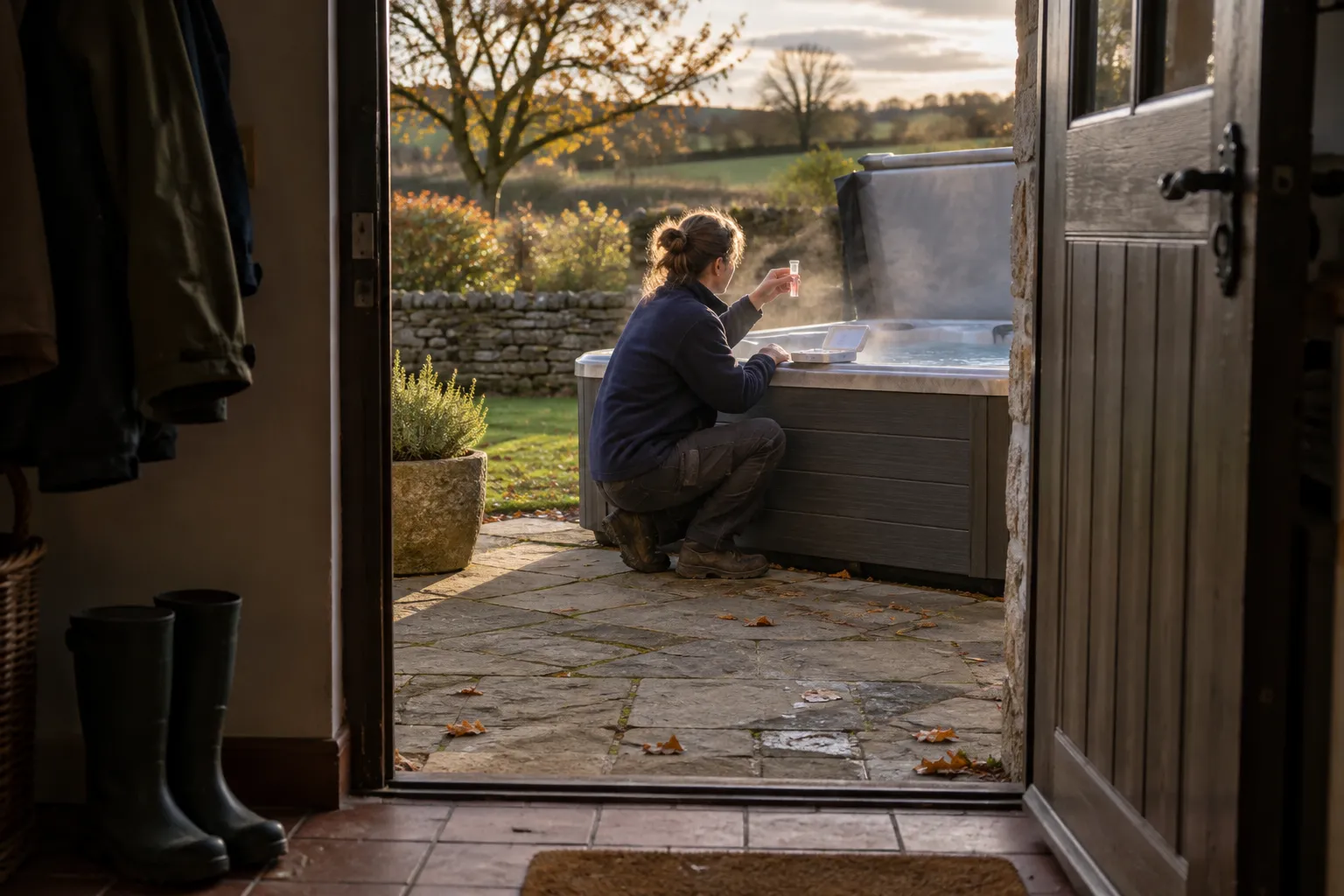
- Water checks at least twice a day, depending on the risk assessment and usage: clarity, pH and the disinfectant level, plus a daily check that the dosing is working. The guidance’s typical ranges are pH 7.0 to 7.6, and 3 to 5 mg/l of chlorine or 4 to 6 mg/l of bromine. Readings past the guidance’s action limits close the tub until it is put right, and for pH that means anything outside 7.0 to 7.6.
- A full drain, clean and refill between each group of users, or at least weekly, whichever comes first. The filter cartridge is checked, cleaned, disinfected and dried on the same timetable.
- Weekly, an inspection of the accessible pipework and jets.
- Monthly, a water sample tested by a UKAS-accredited laboratory for the overall bacterial count, coliforms, E. coli and Pseudomonas aeruginosa, and every three months a legionella sample.
- Records. Monitoring, test and check records are kept for at least five years, and the risk assessment for as long as it is current plus two years.
One week at a let hot tub
Fourteen water checks, two full drains, one jet inspection
An illustrative week with two bookings: three nights from Friday, then four nights from Monday. Each grey dot is a check of clarity, pH and disinfectant; each dark teal bar is a changeover.
- FriDrain, clean, refill, reheatCheckCheck
- SatCheckCheck
- SunCheckCheck
- MonDrain, clean, refill, reheatCheckCheck
- TueCheckCheck
- WedInspect pipework and jetsCheckCheck
- ThuCheckCheck
Once a month: a lab sample for bacteria.
Every third month: a lab sample for legionella.
The twice-daily check is the real decision
The water checks have to be done by somebody competent, and that somebody cannot be the guest. Argyll and Bute Council’s guidance for holiday lets with hot tubs says you should never rely on hirers managing the chemical treatment. Anglesey’s council made the same point to its holiday-let businesses: guests cannot do the checks because they are not competent to do so.
So a hot tub turns a holiday let into a property that needs a trained person on site every day guests are staying, with a test kit, a record sheet and access to the tub without walking through the guests’ living room. Training is available from spa suppliers and installers, and the training records belong in the file with the test results.
This is where most hot tub decisions are actually made. An owner who lives twenty minutes away and enjoys the routine can run it. An owner three hours away needs a caretaker or a manager who already visits the area daily, and the cost of that visit belongs in the sum before the tub is ordered. Tell guests in the listing that someone checks the hot tub each day and roughly when, so the visit arrives as part of the service.
What a hot tub does to your changeovers
Every changeover becomes a drain, a clean, a refill and a reheat, and the reheat is the part that catches owners out. Whether a tub refilled with cold mains water at 11am is hot by a 4pm check-in depends on its volume and heater rating, both on the manufacturer’s specification sheet, so read them before you set your check-in time and before you buy.
Shorter stays mean more drains: more water, more chemicals, a longer clean and a longer gap before the next guests. That is a reason to set a minimum stay your changeover can pay for and to stop chasing one-night gaps, and to make sure the cleaning fee covers the extra work at the tub.
Rigid, inflatable or shared: which hot tub
HSE’s guidance describes the domestic-type hot tubs used in businesses as rigid or inflatable, fitted with an inline disinfectant feeder, and built for a small group of people who know each other. Some councils go further: Argyll and Bute’s March 2020 guidance says inflatable spa pools are not acceptable for commercial use, and that a domestic-type tub in a single holiday let must have continuous dosing. Before you buy, check your own council’s environmental health pages, and buy a rigid tub with a feeder if they are silent.
A tub shared between several units is a different product. HSG282 says a domestic-type tub is unsuitable where several accommodation units share access, or where use is heavy or continuous, as with party spas. Those settings need a commercial-type spa pool, with the plant, automatic chemical control and budget that come with it.
Electrics, siting and the neighbours
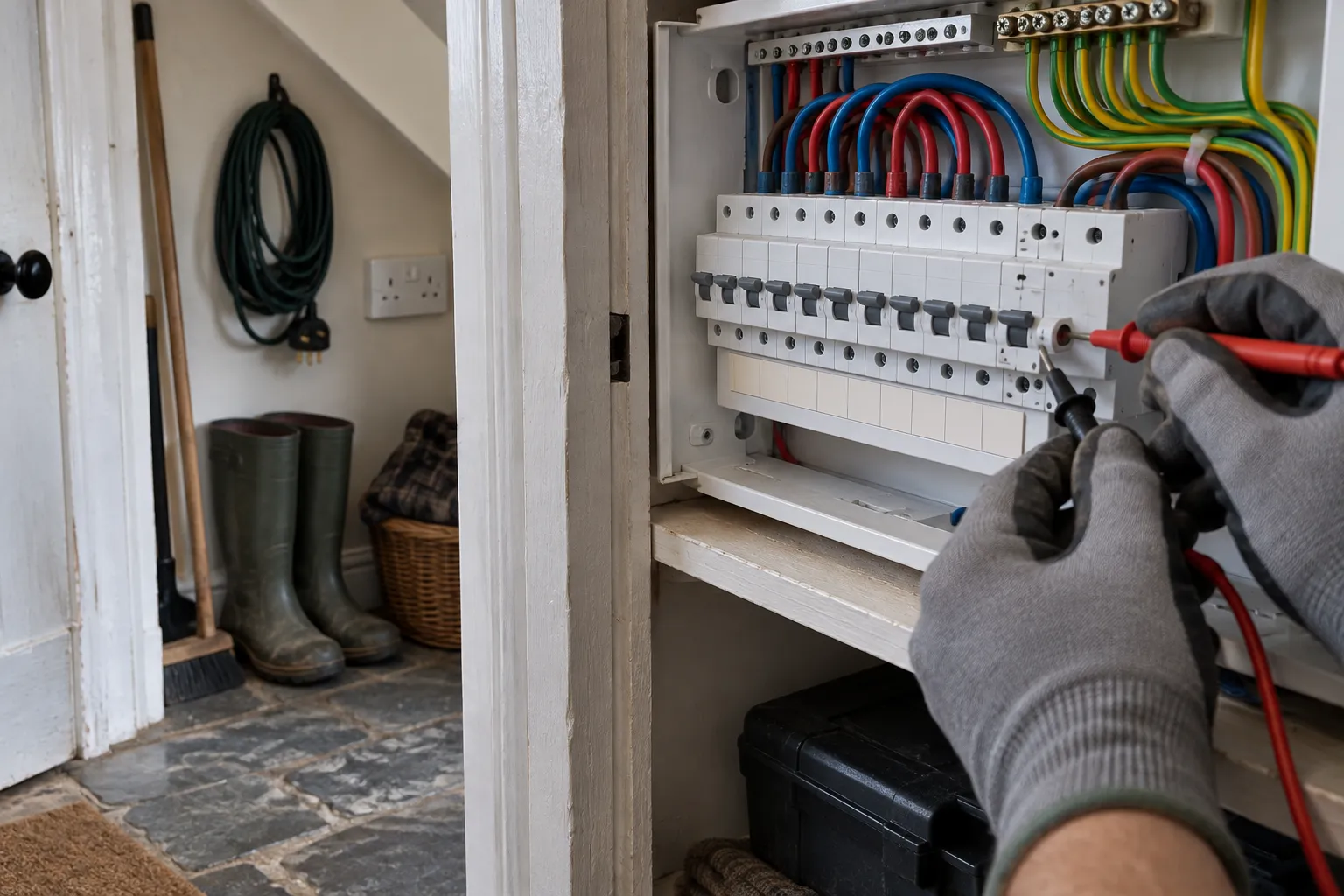
Council guidance says most hot tubs need their own circuit, so check the manufacturer’s specification. In England a complete new circuit is notifiable building work under Part P. A registered competent person can self-certify it; otherwise the work has to be notified to building control, or a registered third-party certifier appointed, before it starts. The Institution of Engineering and Technology’s guidance on supplies to hot tubs says the supply should be protected by a 30 mA RCD, and that buried cables need armour or a suitable enclosure, laid at least 500 mm below the lowest ground level. You should get an Electrical Installation Certificate for the work, and the circuit then becomes part of the five-yearly electrical inspection the rest of the property already has.
Where the tub goes matters too. Council guidance for holiday lets asks for a level, hard, cleanable surface, a paved or boarded route to keep feet and water clean, a spot away from overhanging trees and roof run-off, and an area that unsupervised children cannot get into. On a terrace or close to a neighbour’s bedroom window, voices in a hot tub at 11pm carry, and the rules for parties and noise complaints apply to the garden as much as the house.
House rules and what to tell guests
Airbnb’s safety requirements for homes name hot tubs twice. Hosts are asked to provide instructions for any feature that could cause injury if used improperly, with hot tubs as the example, and to deal with known hazards, including poorly maintained hot tubs and contaminated water, before accepting reservations.
Council guidance for holiday-let hot tubs suggests rules a guest can follow and you can check:
- Shower before using the hot tub.
- No glass in or around it.
- Children supervised at all times, and under-fours kept out, because they cannot regulate their body temperature in hot water.
- No use after alcohol, drugs or medication that impairs you.
- No more than the tub’s stated number of people.
- Sessions of no more than about fifteen minutes.
Put the rules in the house manual and on a weatherproof card at the tub, and tell your insurer about the hot tub before the first guest uses it, checking that the holiday let insurance covers injury to a guest from it.
When a hot tub is the wrong call
- Nobody can reach the property every day. The twice-daily checks are the job, and without someone to do them the tub stays off.
- The calendar is mostly one and two night stays. Every changeover is a full drain and reheat, and the gaps between bookings get shorter as the work gets longer.
- The tub would be shared between units. That is a commercial spa pool, a different spend and a different level of control.
- The garden backs onto bedrooms. A tub that brings complaints costs more in reviews and neighbour goodwill than it adds in rate.
What a hot tub costs to run, as a sum
Work it out for your own property before you buy, line by line:
- Electricity: the heater and pump ratings in kW, multiplied by the hours they run, multiplied by your unit rate.
- Water: the tub’s volume, multiplied by the number of changeovers a year, priced at your water company’s rate.
- Chemicals and filters: disinfectant, pH adjusters and replacement cartridges, from the supplier’s price list.
- Lab samples: twelve bacterial samples and four legionella samples a year, priced by a UKAS-accredited lab near you.
- The daily visit: the caretaker’s time for two checks a day, every day guests are staying.
Set that total against the extra nightly rate and the extra booked nights your comparable listings show. If the comparables with hot tubs do not charge or book enough more to cover it, the tub is a cost.
Whether a hot tub pays is a pricing question, and the answer lives in the listings your property competes with. If you are weighing one up, our free valuation starts from those comparable listings, so you can see what your home could earn as a holiday let before you spend on the garden.
Frequently asked questions
Do you need a legionella risk assessment for a hot tub in a holiday let?
Yes, if paying guests use it. HSE’s guidance puts a hot tub let as part of a rental agreement under the general duties of the Health and Safety at Work etc. Act 1974, and those duties start with assessing the risk. Council guidance for holiday lets adds a separate assessment under the COSHH Regulations 2002 for legionella and the pool chemicals.
How often should you change the water in a holiday let hot tub?
Between every group of guests, or at least weekly, whichever comes first. HSE’s guidance sets that frequency for domestic-type hot tubs used in a business, with the whole system drained, cleaned and refilled each time and the filter cartridge cleaned, disinfected and dried.
Can guests test the hot tub water themselves?
No. The checks need a competent person, and council guidance for holiday lets says you should never rely on hirers managing the chemical treatment. Guests can follow house rules that keep the water cleaner, but the testing, dosing and record keeping stay with you or your manager.
Can you put an inflatable hot tub in a holiday let?
HSE’s guidance includes inflatable tubs in its description of domestic-type tubs used in a business, but some councils do not accept them for commercial use. Check your own council’s environmental health guidance first, and choose a rigid tub with an inline disinfectant feeder if in doubt.
Sources
- HSE: The control of legionella and other infectious agents in spa-pool systems (HSG282) (paragraphs 39, 53, 63, 75 to 79, 101 and 153; Table 1, domestic-type frequencies; Table 3, pH and disinfectant ranges; published January 2017; read 2026-10-27)
- HSE: Spa-pool systems (scope of HSG282, domestic-type hot tubs used by a business; updated 28 October 2024; read 2026-10-27)
- Argyll and Bute Council: Legionella in spa pools: FAQs for holiday lets (risk assessments, inflatable pools, continuous dosing, user rules, siting, never relying on hirers; March 2020; read 2026-10-27)
- Isle of Anglesey County Council: Businesses reminded of hot tub and spa legionella risk (duty under the 1974 Act; guests not competent to do the checks; 16 June 2021; read 2026-10-27)
- GOV.UK: Letting out a self-catering holiday home in England: rules and regulations (no mention of hot tubs or legionella; last updated 2 October 2026; read 2026-10-27)
- Airbnb: The amenities guests want (hot tub sixth of the ten most-searched amenities, worldwide, 1 January to 31 December 2025; published 31 August 2026; read 2026-10-27)
- Airbnb Help Centre: Safety requirements for homes (instructions for hot tubs; known hazards before accepting reservations; read 2026-10-27)
- Planning Portal: Electrics: building regulations general information (a complete new circuit is notifiable; competent person schemes; read 2026-10-27)
- The IET: Domestic electrical supplies to hot tubs (30 mA RCD, buried cables at least 500 mm deep, Part P certification routes; read 2026-10-27)