Winter bookings go to the holiday lets built for short trips. British residents took 48.7 million overnight trips in Britain in January to March and October to December 2025, 47% of the year, and those trips were shorter than summer ones. So the winter calendar fills on two-night stays from any arrival day, a listing that sells a reason to come, and the long stays summer cannot take.
What empties a holiday let in winter is usually a set of summer rules left running into November.
Winter demand is real, and it comes in short trips
The Great Britain Tourism Survey, the official count of overnight trips British residents take at home, puts the year’s shape in plain numbers. In 2025, October to December carried more trips than April to June, and January to March carried as many. Only July to September stands clearly above the rest.
What changes in winter is the length. The average trip from January to March 2025 lasted 2.7 nights, against 3.3 nights from July to September. October to December works out at 2.8.
Great Britain, 2025, by quarter
Winter travel is busy and brief
Bars show overnight trips taken in Britain by British residents. The right-hand figure is how long the average trip lasted.
Jan to MarWinter
2.7nights
Apr to JunSpring
2.8nights
Jul to SepSummer
3.3nights
Oct to DecWinter
2.8nights
The survey counts every overnight trip in Britain, including stays with family and work trips, so it is a measure of how much the country travels in winter, which is the demand every holiday let draws on. The people are travelling. They are taking two and three nights at a time, and a listing that only sells a week from Saturday is closed to the short trips that make up the season.
Who books a holiday let in winter
Six kinds of guest fill winter calendars, and each one needs something slightly different from the listing.
- Couples and friends on short breaks. Two or three nights, often midweek. They want the fire, the walk from the door and a good pub, and they compare the total price.
- Families and groups at Christmas and New Year. The one winter peak most owners already know about. They care about bed count, a big table and a house that stays warm when it is full.
- Families in the February half-term. A school-holiday week that books like a short summer, set by each council's term dates.
- People visiting family who need a bed nearby. Visiting friends and relatives was the biggest single reason for overnight trips in Britain in 2025, 37.01 million of 103.00 million. When the family house is full at Christmas, the overflow books something close.
- People working away. Business trips were the only purpose that grew in Britain in 2025, up 7% to 6.28 million. Contractors, hospital staff and project teams stay for a week, a month or a winter.
- People between homes. A sale that has not completed, a house being renovated, a flood or fire claim. They need a furnished home for weeks, and their dates are set by the problem, whatever the season.
The first three are leisure guests and come through Airbnb and the booking sites. The last three are the mid-term lets market, and they find you through different channels, which is why a winter plan has two halves.
The settings that open a winter calendar
Most of a winter calendar is decided in the settings, before a single photo changes. Four of them do the work.
Minimum stay of two nights, one on the gaps. The average winter trip is under three nights, so a three-night minimum shuts out a large share of the people travelling. Two nights on weekends and one night on midweek gaps catches them, as long as your cleaning fee and changeover cost are covered by the stay. Our guide to setting an Airbnb minimum stay covers the tools for setting it by day of the week and by date.
Any arrival day. A fixed Saturday changeover suits a summer of week-long bookings. In winter it turns away the Thursday-to-Sunday break and the Sunday-to-Wednesday one, and those are the trips people are taking.
Weekly and monthly discounts. Airbnb’s weekly discount applies to stays of 7 nights or more and its monthly discount to stays of 28 nights or more. Its help centre says discounts of 10% or more are displayed in search results, and that some stays of 28 nights or more also get Airbnb’s own monthly stay savings, which Airbnb pays for in full and does not take from your payout. A winter weekly discount is how a quiet midweek becomes a sold week.
Price cuts big enough to show. Airbnb crosses out the old price beside a new one only when the price for that night is at least 10% below the median it has carried over the previous 60 days. A run of small cuts can lower the price for weeks without a guest ever seeing a crossed-out figure. One clear cut of 10% or more, made on the dates that need it, shows in search. The dynamic pricing guide covers where your winter floor should sit, so the cut never goes below what the stay costs you.
The winter calendar for 2026 to 2027
The dates move every year, and this winter they fall in a way that rewards a flexible arrival day. Christmas Day 2026 is a Friday, so the Boxing Day bank holiday moves to Monday 28 December and England and Wales get a four-day Christmas weekend. New Year’s Day is also a Friday. Scotland adds a substitute 2nd January holiday on Monday 4 January.
November 2026 to March 2027
The dates to set before the guests search
Each date with the setting it needs. Load them into the calendar now, while guests are still choosing.
Nov
Monday 30 November
St Andrew's Day, Scotland
A long weekend for many Scottish guests. Allow a Friday-to-Monday stay.
All month
The quietest weeks
Weekly discount on, two-night weekends, one-night midweek gaps.
Dec
Thursday 24 to Monday 28 December
Christmas, a four-day weekend
Price by hand. Thursday or Friday arrivals, three or four nights.
Thursday 31 December to Sunday 3 January
New Year, a Friday holiday
Price by hand. Thursday arrivals; Scotland runs to Monday 4 January.
Jan
From Monday 4 January
Long stays and workers
Monthly discount on, a month-long block offered to work and relocation guests.
Feb
Sunday 14 February
Valentine's weekend
Two nights, Friday and Saturday, priced as a weekend.
Mid-February, by council
February half-term
Check the term dates where your guests live. Sell the week and the short break.
Mar
Sunday 7 March
Mothering Sunday
Family groups for the weekend. Two nights.
Friday 26 to Monday 29 March
Easter
The start of spring pricing. Easter Monday is not a holiday in Scotland.
A Saturday-to-Saturday rule sells neither the Christmas weekend nor the New Year one well this year. Open Thursday and Friday arrivals across both, and price those nights by hand.
Sell the reason to come in your listing
A winter guest is choosing a few nights away, and the listing has to make the case for them. The photographs and the first lines of the description do most of it.
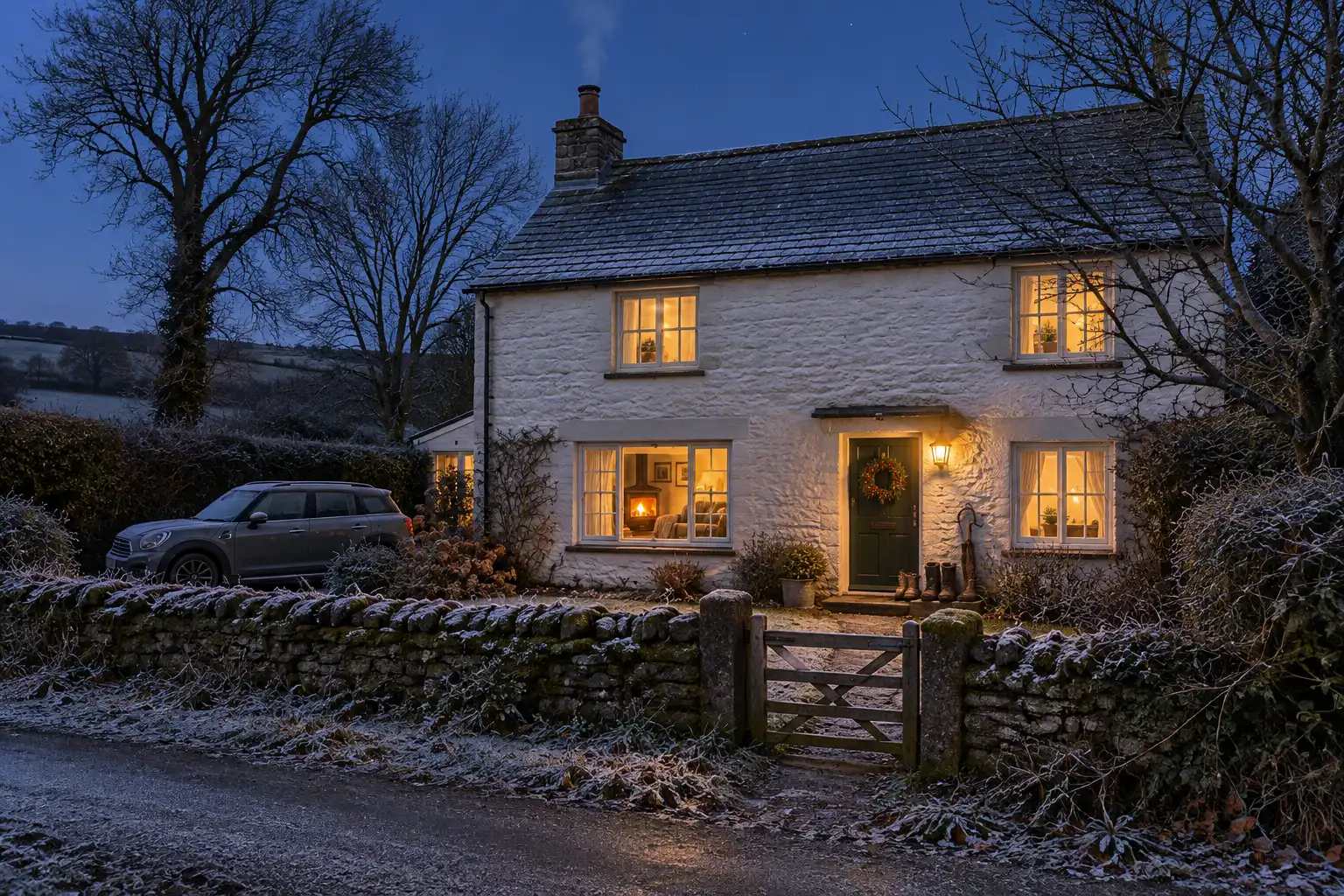
- Winter photographs. The fire lit, the bedroom lamps on, boots by the door, the beach or the hill on a bright cold day. A listing shot in July sells July. Our guide to Airbnb listing photography covers what Airbnb asks for and how it orders the gallery.
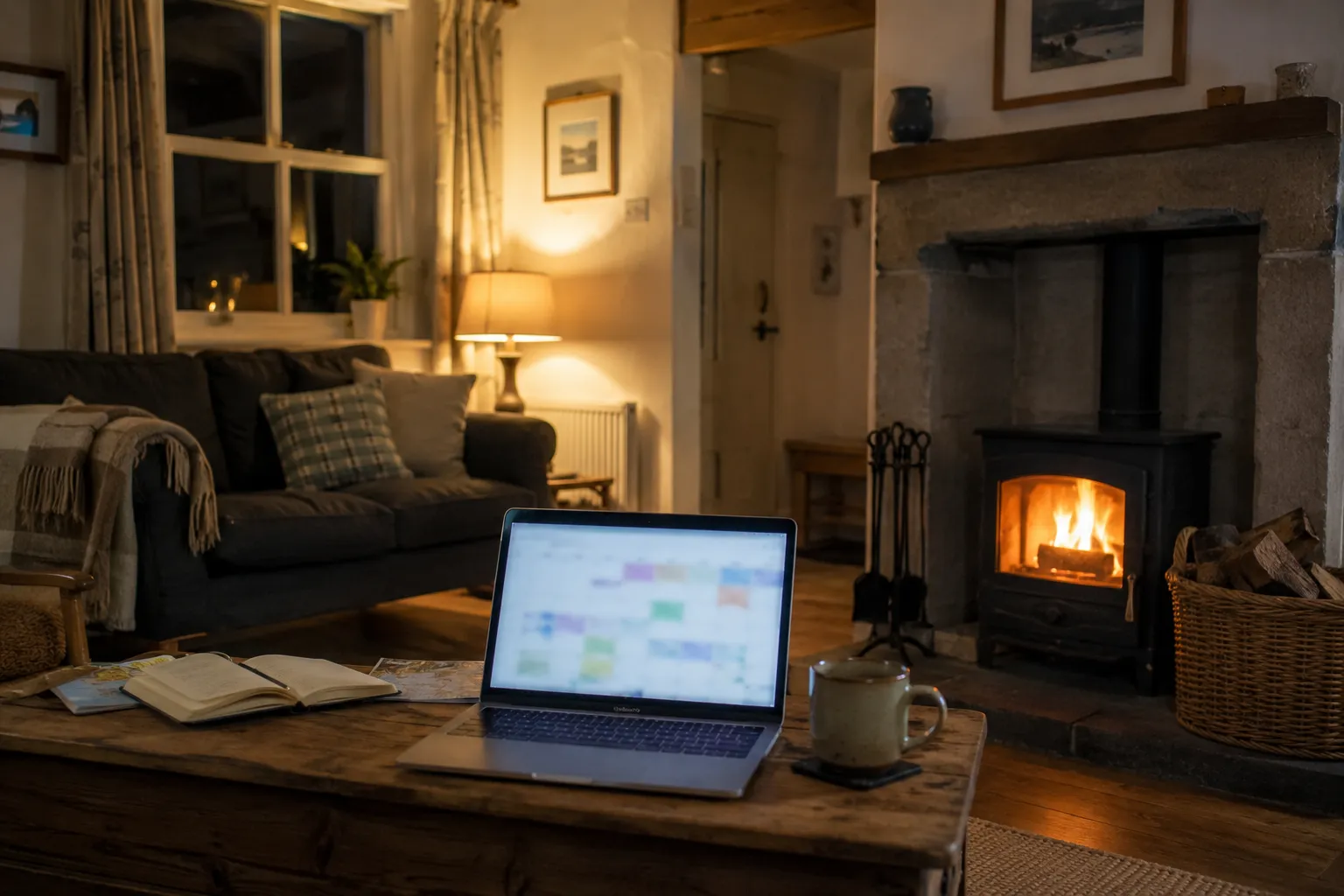
- Warmth, stated as fact. The heating type, whether it is on a timer, the wood burner and where the logs come from, a heated towel rail, somewhere to dry wet coats. Say it plainly, because a guest booking for January wants to know the house will be warm.
- The reason in the first line. A winter guest searches for a break, so open the description with the walk, the pub, the dark skies or the storm-watching, and the listing description guide covers the rest of the page.
- Dogs. Winter walkers often travel with one. If your property can take dogs, say so in the title and the photos, and our guide to allowing dogs in a holiday let covers the fee, the rules and the cleaning.
Past guests are the other winter audience. The ones who booked with you directly, and agreed to hear from you, can be told about the winter dates first. The direct bookings guide covers what the email rules allow and what Airbnb’s off-platform policy forbids.
Take the long stays summer cannot
Winter is the season when a long stay gives up the fewest nights you could have sold. A month to a contractor or a family between homes is one changeover for thirty nights, and it fills the January weeks the short-break market leaves empty.
Two rules come with it. In England, stays longer than 28 nights do not count toward the 70 nights of actual letting a property needs for business rates, so a winter of month-long lets has to sit alongside enough short stays through the year. And a long stay raises the tenancy question, which our guide to mid-term lets answers in full. Take the long stays deliberately, with both answered first.
Use the weeks that will not sell
Every holiday let has a few winter weeks no setting will fill, and they are the cheapest weeks of the year to block. Put the deep clean, the redecoration and your own stays there. Move your gas safety check into them too, so the engineer never needs a peak night.
A property empty for weeks in winter also needs looking after. Read the unoccupancy clause in your insurance before the first cold snap, because it sets how many consecutive days the property may stand empty before cover can lapse.
When closing for winter is the right call
Closing makes sense when a winter stay costs more to service than it earns. Work it out for your own property: take the price your quietest winter weekend would actually sell at, subtract the platform fee, the changeover, the laundry and the extra heating, and see what is left. The payout calculator does the first part.
If what is left is close to nothing, and the property sits somewhere with no winter reason to visit and no long-stay demand nearby, close the short-stay calendar, take one long let if you can find a good one, and spend the weeks on the work. That is a decision about one property and one season. It is never a reason to leave the summer rules running and wait.
What it takes to fill a winter calendar
Winter is where marketing shows. In November the guests are still travelling, and the bookings go to the listings that let them stay two nights, show them a warm house and give them a reason to come.
Running both halves of that is what our holiday let management covers: the short-break pricing and settings, the winter listing, and the long-stay market behind them. If you want to see what your property should earn across the whole year, winter included, get a free Airbnb valuation. It takes about a minute, and the figures come back with their assumptions written down.
Frequently asked questions
Is it worth keeping a holiday let open in winter?
For most UK holiday lets, yes. British residents took 48.7 million overnight trips in Britain in the two winter quarters of 2025, nearly half the year. The test for your own property is whether your quietest winter weekend, at the price it would sell for, earns more than the changeover, laundry, heating and platform fee it costs.
What changeover day should a holiday let use in winter?
Any day. Winter trips in Britain averaged under three nights in 2025, and a fixed Saturday changeover turns away the Thursday-to-Sunday and Sunday-to-Wednesday breaks. In 2026 Christmas Day and New Year’s Day both fall on a Friday, so Thursday and Friday arrivals matter most over the holidays.
Should I offer a monthly discount on Airbnb in winter?
Yes, if a month-long stay suits your property and the business rates and tenancy questions are answered first. Airbnb’s monthly discount applies to stays of 28 nights or more, and Airbnb sometimes adds its own monthly stay savings on top, paid by Airbnb and not deducted from your payout.
Sources
- Welsh Government: Domestic GB tourism statistics: January to March 2025 (Great Britain Tourism Survey; Table 1, 22.03 million overnight trips and 58.95 million nights in Great Britain; Table 4, 2.7 nights a trip; first published 31 July 2025, updated 14 October 2025; read 2026-10-30)
- Welsh Government: Domestic GB Tourism Statistics: April to June 2025 (Table 1, 22.01 million trips and 62.50 million nights; published 14 October 2025; read 2026-10-30)
- Welsh Government: Domestic GB Tourism Statistics: July to September 2025 (Table 1, 32.29 million trips and 105.78 million nights; 3.3 nights a trip; published 23 December 2025; read 2026-10-30)
- Welsh Government: Domestic GB Tourism Statistics: 2025 (provisional) (Table 22, October to December 2025, 26.67 million trips and 73.94 million nights, provisional; Tables 10 and 11, the 2025 year by purpose: 103.00 million trips, 37.01 million visiting friends and relatives, 6.28 million business, up 7%; published 30 June 2026; read 2026-10-30)
- GOV.UK: UK bank holidays (England and Wales, and Scotland, November 2026 to March 2027; read 2026-10-30)
- Airbnb Help Centre: Weekly and monthly discounts for home stays (7 and 28 night thresholds, discounts of 10% or more shown in search, Airbnb monthly stay savings; read 2026-10-30)
- Airbnb Help Centre: Why some prices are crossed out (crossed-out price at least 10% below the median of the previous 60 days; read 2026-10-30)