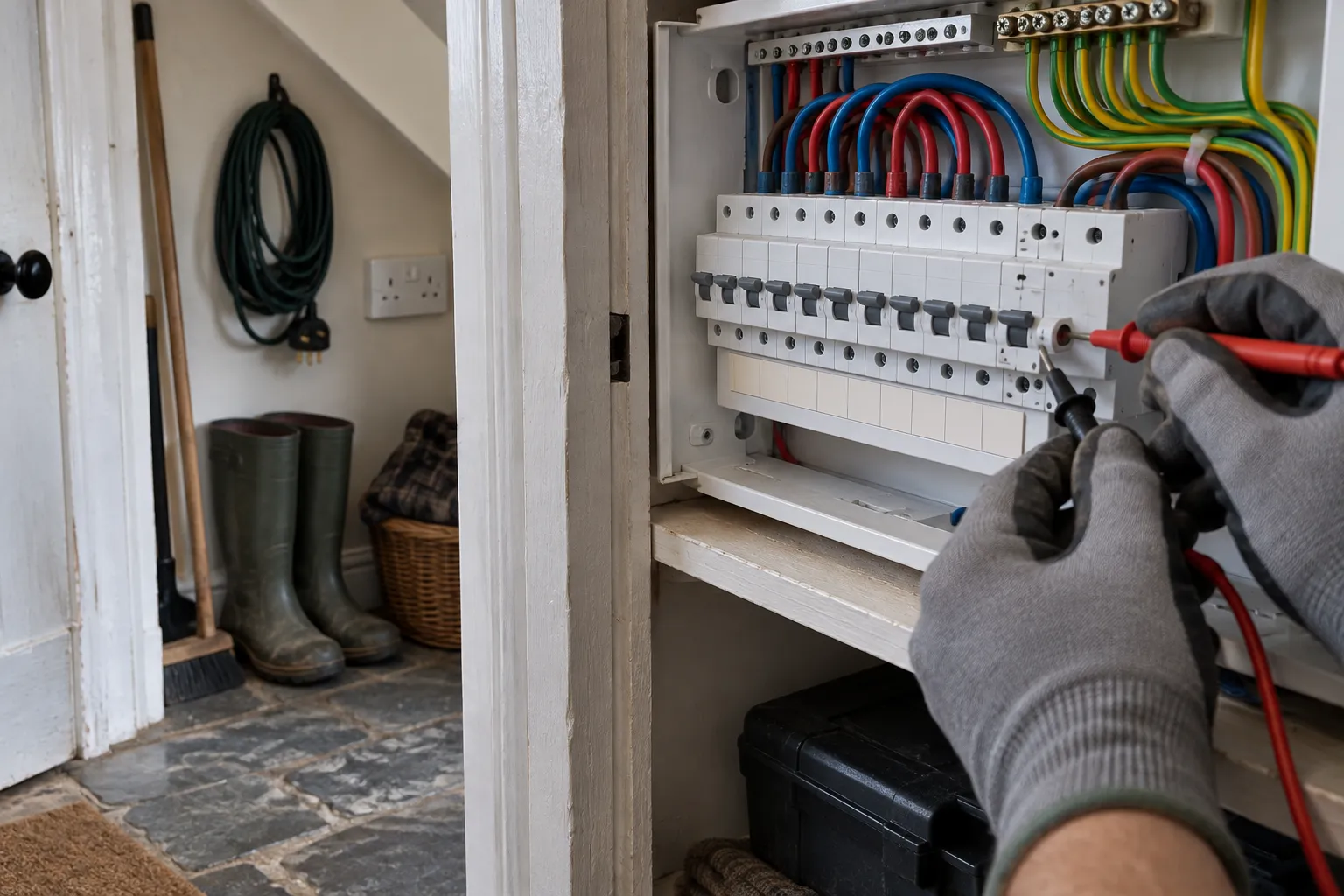
Yes. A holiday let should have its fixed wiring inspected and tested by a qualified electrician at least every five years, and the Electrical Installation Condition Report (EICR) that comes out of that visit is the document owners call the electrical safety certificate. In England and Wales the duty runs through fire safety law. In Scotland it is a licence condition, and appliance testing comes with it.
Which law the duty sits in decides what else you have to do, and it is a different law from the five-yearly EICR rule that landlords of ordinary tenancies follow.
Why the landlord EICR rule does not cover a holiday let
The rule most owners have heard of is the Electrical Safety Standards in the Private Rented Sector (England) Regulations 2020. It applies to a “specified tenancy”, which regulation 2 defines as one that grants the right to occupy the property as the occupier’s only or main residence, in return for rent. A licence to occupy counts as a tenancy for this purpose. What takes a holiday booking outside the regulations is the residence test: nobody makes a week in a cottage their only or main home.
Wales reaches the same place by a different route. Its fitness regulations require a valid electrical condition report, renewed at least every five years, for homes let under an occupation contract. Schedule 2 to the Renting Homes (Wales) Act 2016 says a tenancy or licence for the purposes of a holiday is not an occupation contract unless the landlord gives notice that it is to be one.
Where the five-year inspection comes from in England and Wales
It comes from fire safety. The Regulatory Reform (Fire Safety) Order 2005 requires a written fire risk assessment for every holiday let in England and Wales. The UK government’s guide for small paying guest accommodation in England, issued under article 50 of the Order, opens its electrical section plainly: “Electrical equipment and wiring are common causes of fire.”
The guide then sets the standard. It says you must make sure your wiring has been checked by a qualified contractor, that the installation should be inspected and tested at least every five years, that any work on it should be done only by a competent electrical contractor, and that the fuse board and circuit breakers should be in good condition and correctly labelled. Its fire risk assessment checklist asks the question directly: “Are fixed electrical installations inspected and tested every 5 years?”
The guide carries legal weight. Article 50(1A) of the Order says that in any proceedings, proof of a failure to follow the applicable guidance may be relied on as tending to establish a breach, and proof of following it may be relied on as tending to establish that there was none. An in-date EICR is how you show you followed it. The Order applies in Wales as well, so a Welsh fire risk assessment has to deal with the electrics too, and the five-year inspection is the standard to work to there.
GOV.UK’s page for owners letting a self-catering holiday home in England points the same way. Under electrical safety it tells you to follow HSE’s guidance and the government’s guidance on electrical safety standards in rented homes, which is where the EICR process is set out.
How often a holiday let needs an EICR
At least every five years, or sooner if the electrician’s report sets an earlier date. Scotland’s licence condition says the same in its own words: every five years, or more often if the competent person directs.
Five years is long enough to forget. Laid out against the other certificates a holiday let carries, it is the one with the fewest visits and the most time between them.
One holiday let, ten years, every required visit
Ten gas checks, two electrical inspections, one EPC
Each dot is a visit that produces a document, placed to scale on a ten-year line starting from the day the property is first let.
Gas applies only where there is a gas appliance. An electrician can set an earlier date than five years on the report.
The practical move is the one that works for gas. A gas safety check is annual, so in the year the EICR falls due, book the electrician into the same quiet week as the gas engineer. The property is closed to guests once instead of twice, and both documents carry dates in a month your calendar can spare. An inspection forced into August means blocking a peak night; one in late January rarely displaces a booking.
What the EICR checks, and what the codes mean
The EICR reports on the condition of the fixed installation: the consumer unit, the circuits and wiring, and the sockets, switches and light fittings. The electrician tests as well as looks, and records anything that falls short against the current wiring standard, British Standard 7671, which the government’s rented-sector guidance names as the 18th edition of the Wiring Regulations.
Each defect gets a code, and the codes decide whether the report is satisfactory.
EICR observation codes, most serious first
One C1, C2 or FI makes the whole report unsatisfactory
The line marks where a report stops being satisfactory. Everything above it needs work before the next guests.
- C1
Danger present. Risk of injury.
Make it safe before any guest stays again.
- C2
Potentially dangerous.
Remedial work by a qualified person, booked straight away.
- FI
Further investigation required without delay.
The inspector could not rule out a danger. Have it investigated, then fixed if needed.
Satisfactory below this line
- C3
Improvement recommended.
Worth planning into the next refurbishment. The report can still pass.
The tenancy regulations give a landlord 28 days to complete remedial work, or less if the report says so. A holiday let has no statutory clock of its own, and a fortnight’s gap between bookings is no reason to wait for one. A C1 or C2 found on Tuesday should be fixed before Friday’s guests arrive, because a fault you have been told about in writing is exactly what a fire risk assessment exists to catch.
Do you need PAT testing for a holiday let?
In England and Wales, no law sets a PAT test interval for a holiday let, and in Scotland the licence requires a PAT report. That is the sharpest difference between the nations.
HSE is direct about the English and Welsh position. Its guidance on portable appliance testing says the regulations do not make inspection or testing of electrical appliances a legal requirement, do not require it annually, and do not require tested equipment to be labelled. Equipment should be checked often enough that there is little chance it becomes dangerous between checks.
The fire safety guide still expects appliances to be looked after, and its checklist asks: “Are electrical appliances periodically inspected and tested?” It also says:
- carry out a visual check that every appliance appears to be in good condition between lets
- check plugs are not damaged or overloaded and have properly rated fuses
- keep washing machines, tumble dryers and other white goods clean and in good working order
- register appliances with the manufacturer and check them against current recall lists
- avoid extension cables, trailing leads and adaptors wherever practicable
The between-lets check is the one most owners can delegate. It belongs on the changeover list alongside the beds and the bins, because the cleaner is in every room after every stay and the electrician is there once every five years. A frayed kettle flex or a cracked socket found at changeover goes in a photo to the owner before the next guest touches it. A formal PAT test at the interval your electrician recommends, with its record, is then the simplest written answer to the checklist question.
Scotland: a licence condition with three parts
In Scotland, electrical safety is a mandatory condition of every short-term let licence. Paragraph 6 of Schedule 3 to the licensing order applies wherever there are electrical fittings or items in the parts of the property guests use, and it asks for three things:
- Safe condition. Electrical fittings and items must be in a reasonable state of repair and in proper and safe working order.
- An EICR on the fixed installation, from an electrical safety inspection by a competent person at least every five years, or more often if the competent person directs.
- A PAT report on movable appliances guests can use, with every inspected appliance date labelled and signed by the competent person.
Paragraph 7 says that when you decide who is competent, you must have regard to the Scottish Ministers’ guidance on electrical safety in rented homes. Paragraph 12 then requires copies of the EICR and the PAT report to be available in the property, somewhere every guest can reach them. The same folder that holds the gas safety record is the natural place.
The rules guide sets out the rest of the Scottish licence conditions. Northern Ireland has its own regime and sits outside this article.
What each nation asks of a holiday let’s electrics
| England | Wales | Scotland | |
|---|---|---|---|
| Where the duty sits | Fire Safety Order and its paying guest guide | Fire Safety Order | Short-term let licence, Schedule 3 paragraph 6 |
| Fixed wiring | Inspected and tested at least every 5 years | Covered by the fire risk assessment, with 5 years the standard to work to | EICR at least every 5 years, or sooner if directed |
| Appliances | Periodic inspection and testing, no fixed interval in law | Periodic inspection and testing, no fixed interval in law | PAT report, each appliance date labelled and signed |
| Copy for guests | No rule for holiday stays | No rule for holiday stays | EICR and PAT report available in the property |
When a long stay brings the tenancy rules back in
A booking that becomes someone’s only or main residence can bring the 2020 regulations into play in England, and with them a set of paperwork duties that short stays never meet. A contractor on a three-month job will often keep a home elsewhere. A guest who has moved in for six months with nowhere else to live may not, and whether a stay counts turns on its facts, so build the paperwork into your mid-term lets from the start.
Where the regulations apply, regulation 3 requires you to:
- give each existing tenant a copy of the report within 28 days of the inspection
- give a new tenant the latest report before they move in
- give the council a copy within 7 days if it asks in writing
- have remedial or investigative work done within 28 days, or sooner if the report says so
GOV.UK’s guidance says councils may impose a financial penalty of up to £40,000 for a breach. For an owner who keeps an in-date EICR anyway, the extra work is mostly the paperwork: send the report with the booking confirmation and keep proof you did.
Who is responsible for the electrics in a holiday let
The person who controls the property for fire safety purposes, which for most holiday lets is the owner. If a management company runs the let, the management agreement should say who books the inspection, who holds the report and who signs off remedial work, and you should hold a copy of every report, because the property is yours.
How electrics fit with the rest of your safety paperwork
The EICR sits in the same folder as the written fire risk assessment, the gas safety record and the furniture labels and alarms. The compliance checklist keeps the due date for each one, property by property, so a five-year date cannot slip past unnoticed.
A property that books solidly is the one where an expired report does the most damage, because there is never a free week to fix a C2 in. If you are weighing up what your home could earn as a holiday let, our free valuation flags the compliance jobs for your property alongside the calendar they have to fit around.
Frequently asked questions
Is an EICR the same as an electrical safety certificate?
Yes, in everyday use. “Electrical safety certificate” is what owners and booking sites tend to call it. The document is a report on the condition of the fixed installation, and Scotland’s licensing order names it as the Electrical Installation Condition Report.
Who can carry out an EICR on a holiday let?
A qualified and competent electrician. The government’s fire safety guide refers to a contractor certificated by the National Inspection Council for Electrical Installation Contracting (NICEIC), and the rented-sector guidance points to the Registered Competent Person Electrical scheme to find one. In Scotland, competence is judged against the Scottish Ministers’ guidance.
Do I have to show guests the electrical report?
In Scotland, yes: the licence requires the EICR and the PAT report to be available in the property. In England and Wales there is no display rule for holiday stays, though in England a guest whose booking makes the property their only or main home must be given a copy before they move in.
Does a static caravan or lodge need an EICR?
The 2020 tenancy regulations exclude caravans and mobile homes by name. If you let one to paying guests, keep its electrics inspected to the same five-year standard, and check your holiday park’s own terms, which may set conditions of their own.
Sources
- legislation.gov.uk: Electrical Safety Standards in the Private Rented Sector (England) Regulations 2020, regulation 2 (“specified tenancy”: only or main residence, rent; read 2026-10-26)
- legislation.gov.uk: Electrical Safety Standards in the Private Rented Sector (England) Regulations 2020, regulation 3 (five-year interval, copies to tenants and council, 28-day remedial work; read 2026-10-26)
- legislation.gov.uk: Housing and Planning Act 2016, section 122 (subsection (6): “tenancy” includes a licence to occupy; read 2026-10-26)
- GOV.UK: Electrical safety standards in the private and social rented sectors: guidance (BS 7671, the C1, C2, FI and C3 codes, excluded lettings including caravans, the £40,000 penalty; published 1 November 2025; read 2026-10-26)
- legislation.gov.uk: Renting Homes (Wales) Act 2016, Schedule 2 (paragraph 3: holiday lettings are not occupation contracts unless notice is given; read 2026-10-26)
- legislation.gov.uk: Renting Homes (Fitness for Human Habitation) (Wales) Regulations 2022, regulation 6 (electrical condition report for occupation contracts; read 2026-10-26)
- GOV.UK: Making your small paying guest accommodation safe from fire (section 5, electrical installations and equipment; section 8, the checklist questions; last updated 20 January 2025; read 2026-10-26)
- legislation.gov.uk: Regulatory Reform (Fire Safety) Order 2005, article 50 (paragraph (1A), the evidential effect of the guidance; read 2026-10-26)
- HSE: Portable appliance testing FAQs (no legal requirement to test, to test annually or to label; read 2026-10-26)
- legislation.gov.uk: Civic Government (Scotland) Act 1982 (Licensing of Short-term Lets) Order 2022, Schedule 3 (paragraphs 6, 7, 12 and 18; read 2026-10-26)
- GOV.UK: Letting out a self-catering holiday home in England: rules and regulations (electrical safety section; last updated 2 October 2026; read 2026-10-26)
- GOV.UK: Energy Performance Certificates when selling or renting (ten-year validity, used in the figure; read 2026-10-26)