Yes. Anyone who lets a holiday home must assess the risk of guests catching Legionnaires’ disease from its hot and cold water, and control what the assessment finds. Most owners can do the assessment themselves, there is no certificate to buy, and in Scotland it is a licence condition. In a holiday let the risk sits in the empty weeks, when water stands still in the pipes.
Here is where the duty comes from, what to check, and how to keep the water moving through a quiet winter.
Where the legionella duty comes from
The duty comes from the Health and Safety at Work etc. Act 1974 and the Control of Substances Hazardous to Health Regulations 2002, which treat legionella as a biological hazard. HSE applies them to landlords, and its definition of a landlord is anyone who rents out a property they own under a lease or licence shorter than seven years. A guest on a week’s booking holds a licence, so the owner is the landlord.
HSE’s technical guidance for hot and cold water systems (HSG274 Part 2) removes the doubt. Landlords providing residential accommodation must make sure the risk of exposure to legionella is properly assessed and controlled, and the guidance says this duty extends to “residents, guests, tenants and customers”.
The duty applies across Great Britain. Scotland adds a licence condition on top, covered below.
You will not find any of this on GOV.UK’s page for letting a self-catering holiday home in England. Its safety sections, last updated on 2 October 2026, cover fire, gas, electrics and EPCs, and the word “water” appears nowhere on it. The duty is in HSE’s guidance instead.
There is no legionella certificate
There is no such thing as a legal legionella certificate for a rented home. HSE says health and safety law does not require landlords to obtain or produce a “legionella test certificate”, and routine sampling of a domestic hot and cold water system is not usually needed. Temperature checks are the reliable way to confirm the water is under control.
So if someone offers to sell you a certificate for your holiday let, what you are buying is an assessment, possibly with a lab sample attached. A professional assessment is a sound choice for a large or unusual system. The law asks for a suitable assessment and sensible controls, and for most cottages and flats that is a job the owner can do.
What a holiday let legionella risk assessment should cover
A holiday let’s legionella risk assessment looks at the places where water can sit warm or still, and the controls that stop it. HSE expects most residential settings to come out low risk, especially small domestic systems where the water turns over quickly, and a simple assessment is enough. Walk the property with these questions:
- How is the hot water made? A combi boiler or electric shower heats water as it is used and stores none, which HSE says lowers the risk. A hot water cylinder stores water, so it needs to hold it at 60°C.
- Is there a cold water tank in the loft? If so, it needs a tight-fitting lid to keep debris and vermin out, and the water in it should stay cool.
- Does the hot water get hot fast enough? HSE’s benchmark is 50°C at the tap within one minute of running it. Cold water should run below 20°C within two minutes.
- Is there pipework going nowhere? Redundant pipes left from an old bathroom or a removed appliance hold still water. HSE’s guidance is to take them out.
- Which outlets go unused? The second bathroom, an en suite in a room guests rarely book, an outside tap, a utility sink. These are the ones that stagnate.
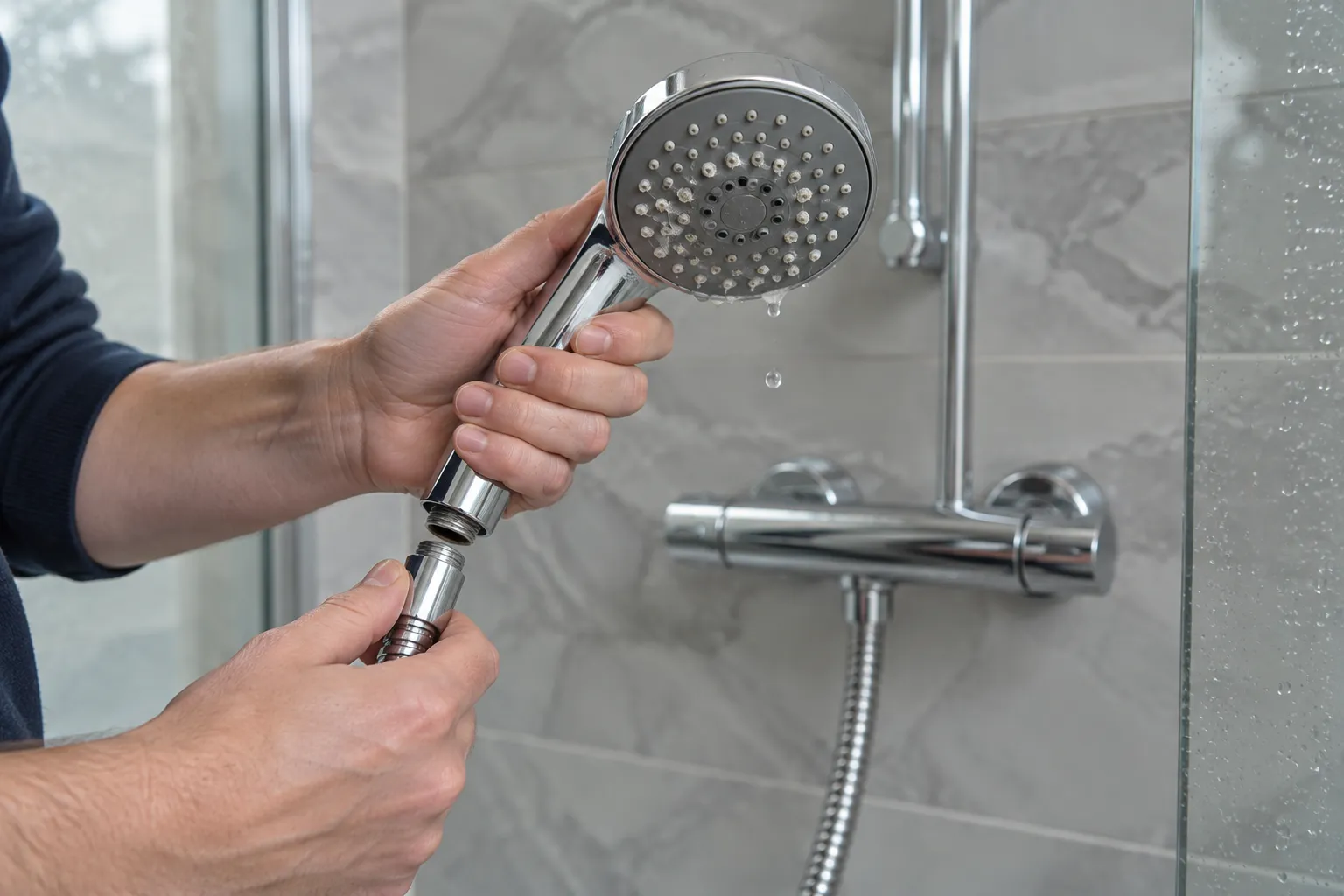
- What state are the shower heads in? Scale on a shower head gives bacteria somewhere to grow, and showers turn water into the fine spray that carries legionella into the lungs.
Then write down what you found and what you are doing about it. HSE says recording the assessment is only a strict legal requirement for employers with five or more employees, and it still advises keeping a record. For a holiday let the record is the only evidence you have that the duty was met if a guest ever falls ill.
A hot tub is a separate system with much heavier rules, including daily water checks and lab samples. Our hot tub guide covers it in full.
Empty weeks are the real risk
The thing that makes a holiday let different from a tenanted home is the gaps. HSG274 says the risk may increase when a property is unoccupied, and sets the general principle that every outlet on the hot and cold system should be used at least once a week. For longer vacancies it points to a flushing regime, or draining the system if the property will stand empty for a long time.
A let that is busy all summer can have gaps of a week or more from November onwards. Each one is a point where the weekly rule is broken unless somebody runs the water.
Six weeks of a holiday let in early winter
Four bookings, two empty stretches, two flushes
An illustrative calendar from Monday 2 November to Sunday 13 December 2026. Shaded days are nights with guests in. A ringed day is the seventh day without anyone running the water, when every tap and shower is flushed.
- Guests in
- Empty
- Flush due
The four empty nights before 6 November and before 13 November stay inside the weekly rule.
The 12 empty nights from 15 November and the 11 from 30 November each reach seven days without water use, so each needs a flush.
How to flush a holiday let’s water system
Flushing means running every outlet until the water coming out has reached its normal temperature. HSG274’s flushing standard is to run each outlet until the temperature at the outlet stabilises and matches the supply, then let it go to drain. In practice:
- Run each cold tap until it runs cold, then each hot tap until it runs hot, starting nearest the boiler or cylinder and working out.
- Run every shower, with the head pointed down into the tray or bath so the spray stays low, and step out of the room while it runs.
- Flush each toilet, and run the outside tap and any utility sink.
- Write the date in the property’s water log.
If the gap runs on, repeat the flush every seven days. For a property shut for the whole winter, HSE’s guidance allows draining the system as the alternative; ask a plumber to drain and refill it, and treat the first refill as a full flush.
The cheapest control is a booked calendar. Water that guests run every day is water that never stands, which is one more reason the winter bookings guide is worth reading alongside this one.
Where the water comes from changes the rules
The duty above applies everywhere. Two extra layers depend on the nation and the supply.
Legionella and water duties by nation and supply
Everyone assesses. Scotland writes it into the licence, and private supplies get tested
The owner's legionella assessment runs through every cell. The teal edge marks where a second duty sits on top of it.
Owner's legionella assessment under health and safety law.
No inspection regime; a record is advised.
The same, plus council risk assessment of the supply at least every five years, and monitoring.
Private Water Supplies (England) Regulations 2016.
Owner's legionella assessment under health and safety law.
No inspection regime; a record is advised.
The same, plus council risk assessment and monitoring under the Welsh regulations.
Ask your council's environmental health team.
Legionella assessment is a mandatory licence condition.
Schedule 3, paragraph 9.
Both licence conditions: the legionella assessment and compliance with the 2017 private supply regulations.
Schedule 3, paragraphs 8 and 9.
Scotland makes it a licence condition
In Scotland, every short-term let licence carries a mandatory condition that the holder “must assess the risk from exposure to legionella within the premises”, whether or not the property is on a private supply. It is paragraph 9 of Schedule 3 to the 2022 licensing order. Many Scottish licensing authorities publish a template form for it, so ask yours before writing one from scratch, and keep the completed form where you can produce it.
A private water supply brings the council in
A holiday let on a well, spring or borehole is a commercial use of that supply. In England, the Private Water Supplies (England) Regulations 2016 require the council to risk assess a single-dwelling supply that is part of a commercial or public activity, and to review that assessment at least every five years. The council also monitors the water, and both the testing and the risk assessment are chargeable. The Drinking Water Inspectorate’s guidance names short-term lets such as holiday cottages as a commercial use.
If your let is on a private supply and you have never heard from environmental health, contact them before your next booking. In Scotland, a private supply is also a separate licence condition, paragraph 8 of the same schedule.
Who is responsible when someone else runs the let
The duty sits with whoever controls the property and its water system, and that is usually the owner. HSG274 says that where a managing or letting agent is involved, the management contract should state clearly who is responsible for the legionella checks. Where it says nothing, the duty falls on whoever has control, which in most cases is the landlord.
So if a cleaner, a co-host or a management company looks after your let, put the water checks in writing: who flushes after a long gap, who keeps the log, and who reviews the assessment. Our guide to what a management agreement should say covers how to divide duties like this.
What happens if you skip it
HSE and council inspectors do not proactively inspect homes or ask landlords for their assessments. The risk shows up later. HSE says that if a tenant catches Legionnaires’ disease from the water system, the landlord may be prosecuted under the Health and Safety at Work Act and would have to show the court they had met their duty. For a holiday let with new guests every few days, the dated assessment and the water log are what that defence is built on.
How water fits with the rest of your safety paperwork
The legionella assessment sits alongside the gas safety check, the electrical inspection, the fire risk assessment and the EPC. The law sets no fixed review date for the legionella assessment, so tie it to a date you already keep: the annual gas check is a sensible anchor, and any change to the boiler, cylinder or bathrooms is a reason to review it sooner. Our rules guide sets out how the duties differ across England, Wales and Scotland.
The water checks also belong in the changeover checklist: a glance at the shower heads for scale on each clean, a full descale on the deep-clean rota (HSG274’s table puts it at quarterly, or sooner where scale builds fast), and a flush before any arrival that follows a week or more of empty nights.
A let that is booked week after week keeps its own water moving. If you want to see what your home could earn, and how full its winter calendar could be, our free valuation shows the figures for your property, and our Airbnb management page sets out what we take on, including support with the safety and compliance checklist.
Frequently asked questions
Can I do a legionella risk assessment for my holiday let myself?
Yes, if you understand your water system well enough to judge it. HSE says most landlords can assess the risk themselves without professional training or accreditation, and Scotland’s licence condition does not require a professional. Bring in a specialist if the system is large or unusual, for example several stored-water tanks, a big house split into units, or a pool or spa.
How often should a holiday let’s legionella assessment be reviewed?
No interval is set in law. HSE says the assessment should be reviewed periodically and whenever the water system changes, such as a new boiler, a new bathroom or removed pipework. Reviewing it alongside the annual gas safety check gives you a fixed yearly date.
Does a combi boiler mean there is no legionella risk?
A combi boiler removes the biggest risk, stored warm water, because it heats water as you use it. Shower heads, unused outlets, redundant pipework and any cold tank still need looking at, and the weekly use rule still applies when the property is empty.
Should I get my holiday let’s water tested for legionella?
Usually not. HSE says routine sampling is not normally needed for domestic hot and cold water systems, and that temperature checks are the reliable way to confirm control. Sampling is for specific circumstances, such as a system that cannot hold its temperatures. A private water supply is different: the council tests it.
Do I need to tell guests anything about legionella?
HSE’s guidance is that landlords should tell occupiers about the risk where appropriate and ask them to report hot water that is not heating properly. For a holiday let, a line in the house manual asking guests to report lukewarm hot water and to run the shower for a moment before stepping in covers it.
Sources
- HSE: Legionella and landlords’ responsibilities (landlord definition, lease or licence under seven years; HSWA sections 3(2) and 53; COSHH; simple assessment, most landlords can do it themselves; flushing before letting, tank lids, 60°C storage, redundant pipework; no legionella test certificate; sampling not usually required; record not strictly required below five employees; no proactive inspection, prosecution risk; outlets used weekly in vacant properties; updated 30 September 2024; read 2026-10-31)
- HSE: Legionnaires’ disease: Technical guidance, HSG274 Part 2 (second edition 2024; storage at 60°C, 50°C within one minute, cold below 20°C within two minutes; paragraph 2.78 and Table 2.1 flushing, equipment unused for seven days or more, flush until temperature stabilises, showers descaled quarterly or as fouling indicates; paragraphs 2.138 to 2.144 landlords, duty extends to guests, agents and contracts, unoccupied properties, weekly use, draining; read 2026-10-31)
- HSE: Hot and cold water systems (temperature controls; updated 28 October 2024; read 2026-10-31)
- legislation.gov.uk: Civic Government (Scotland) Act 1982 (Licensing of Short-term Lets) Order 2022, Schedule 3 (paragraph 8 private water supplies; paragraph 9 legionella; read 2026-10-31)
- legislation.gov.uk: Private Water Supplies (England) Regulations 2016, regulation 6 (risk assessment of single-dwelling supplies provided as part of a commercial or public activity; review every five years; read 2026-10-31)
- legislation.gov.uk: Private Water Supplies (England) Regulations 2016, regulation 9 (monitoring of supplies used as part of a commercial or public activity; read 2026-10-31)
- Drinking Water Inspectorate: Single dwelling supplies (short-term lets such as holiday cottages as commercial use; monitoring and risk assessment by the local authority in England and Wales; chargeable; read 2026-10-31)
- GOV.UK: Letting out a self-catering holiday home in England: rules and regulations (no mention of water or legionella; last updated 2 October 2026; read 2026-10-31)