A holiday let welcome pack needs three things: first-night supplies (milk, tea, coffee, bread and butter), one treat from a producer near the property, and a single page that explains how the house works. Leave the wine out unless the property holds an alcohol licence. In England and Wales, a bottle that comes with a paid stay is alcohol sold to the guest.
The pack is a small cost that decides the first ten minutes of the stay. It is also where two rulebooks most owners have never opened, alcohol licensing and food law, reach the kitchen table.
What a welcome pack is for
A welcome pack does two jobs. It gets guests through their first evening without a trip to the shop, and it shows them that someone prepared the house for them.
The first job matters most where guests arrive late or the nearest shop shuts early, which describes many rural and coastal lets. A family that pulls up at eight in the evening after five hours in the car wants a cup of tea tonight and breakfast for the children tomorrow. Milk in the fridge and a loaf on the side solve both.
The second job is marketing. The pack is on the table when guests walk in, so it is the first thing in the house they judge and the easiest thing for them to mention in a review. Show it before they book as well: put it in the arrival photographs and name what is in it in your listing description. Once the pack is in the listing it is a promise, so the same pack has to be on the table for every arrival.
Keep the pack separate from the basics. Airbnb’s essential amenities are toilet paper, soap for hands and body, one towel and one pillow per guest, and linen for each guest bed. Airbnb says a listing that ticks the essentials option without providing them “may be subject to penalties, including removal from Airbnb”. Guests expect those five and nobody writes a review about loo roll. The welcome pack is what you add on top, and our furnishing checklist covers the kit underneath it.
What to put in a holiday let welcome pack
Build the pack in three layers, in this order, and stop where your budget does.
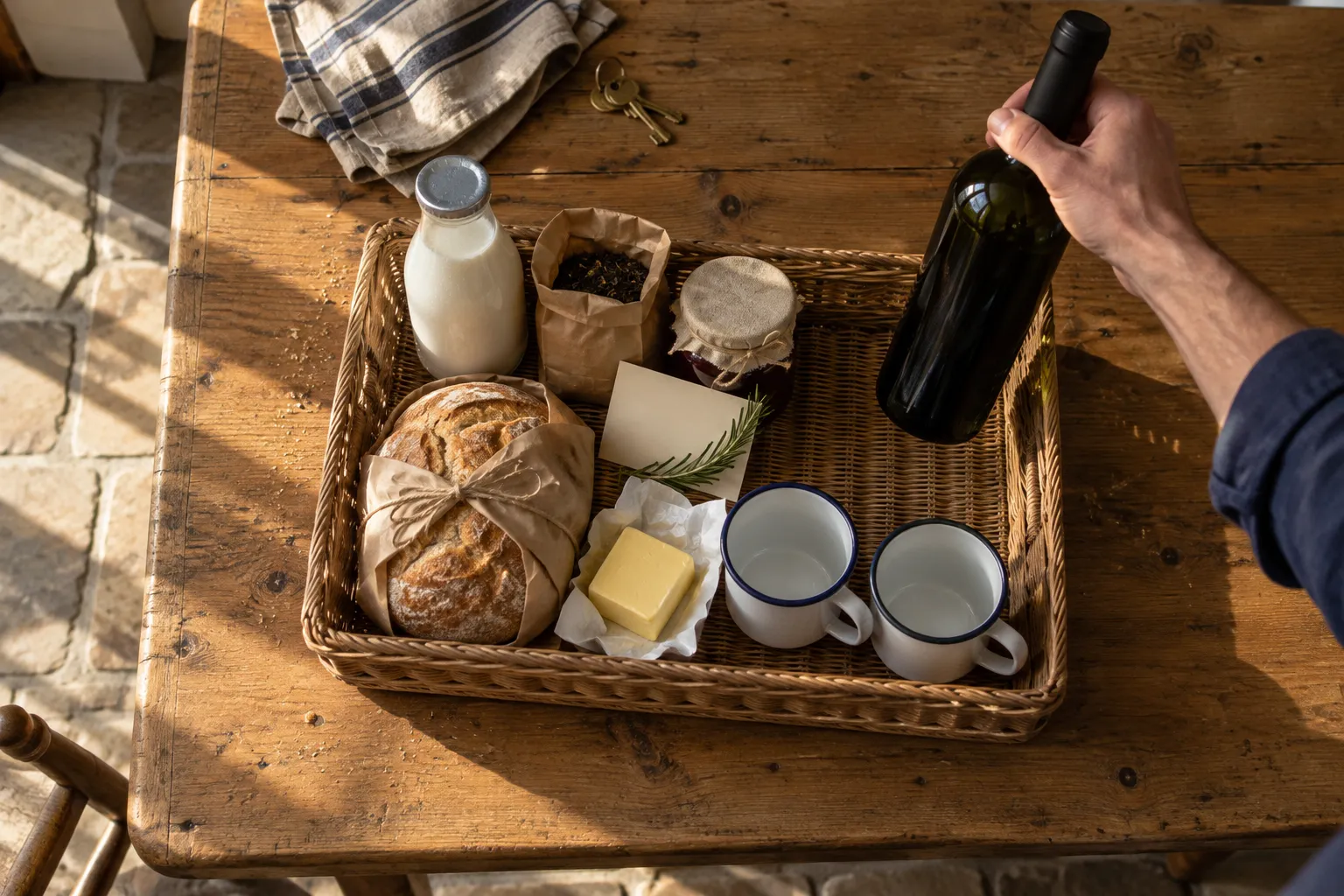
1. First-night supplies. Fresh milk in the fridge, tea, coffee, sugar, a loaf of bread, butter and something to spread on it. Add a carton of long-life oat milk, which keeps unopened in the cupboard until a guest who needs it arrives. This is the layer guests would otherwise have to drive for.
2. One local treat. A jar of jam or honey, a bar of chocolate, biscuits or fudge from a maker near the property, left in the maker’s own packaging. One good thing from five miles away tells guests where they are and gives them somewhere to visit. Say where it came from in your note.
3. One thing for these guests. Read the booking and add a single item for the people who are coming.
| Who is arriving | Add |
|---|---|
| A family with young children | Squash, a box of cereal and something small for the children |
| Guests bringing a dog | A sealed pack of dog treats and a note of the nearest beach or footpath that allows dogs |
| A winter booking | Kindling, firelighters and the first basket of logs, if there is a stove |
| A stay of a month or more | The same first-night supplies, with a list of what you restock and what the guest buys |
| A birthday or anniversary mentioned in the booking | A card with their names on it |
Our guides to dogs in a holiday let, winter bookings and mid-term lets cover what each of those guests is looking for.
Finish with a short note that uses the guests’ names. It costs nothing, and it is the part of the pack that cannot be bought in bulk.
Three things stay out. Anything perishable that nobody will check at the next changeover. Anything opened by the last guests. And alcohol, until you have read the next section.
Can you leave a bottle of wine in a holiday let welcome pack?
Only with an authorisation under the Licensing Act 2003, which for a holiday let means a premises licence. Section 1 of the Act makes “the sale by retail of alcohol” a licensable activity, and section 192 defines that as a sale of alcohol to any person, with one exception for wholesale to the trade. Carrying on a licensable activity without authorisation is an offence under section 136. The penalty is up to six months in prison, a fine, or both.
It is natural to treat a bottle you do not charge for as a gift. The guest paid for the stay and the bottle comes with the stay, so the price of one includes the other. The Home Office described exactly this case when it consulted on the problem in 2012. It wrote that small accommodation providers, “such as guesthouses and self-catering establishments”, wanted to sell “relatively small amounts of alcohol as part of a single contract for the wider service of providing accommodation”. Its two examples were a glass of wine with an evening meal and a bottle of wine in a welcome pack.
What a licence involves
GOV.UK’s guidance says a business that sells or supplies alcohol on a permanent basis needs a premises licence from its council. The licence names a designated premises supervisor, who must hold a personal licence of their own.
The fee follows the property’s non-domestic rateable value. A property with no rateable value, or one up to £4,300, pays £100 to apply and £70 a year after that. From £4,301 to £33,000 the fees are £190 and £180.
A temporary event notice will not cover a weekly changeover. One property can have up to 15 notices in a year, covering no more than 21 days in total. Each notice costs £21, and a person without a personal licence can give five a year.
The fix that was passed and never switched on
Parliament has already written the answer. Section 67 of the Deregulation Act 2015 adds a new Part 5A to the Licensing Act. It lets a business give its council a notice and then make “ancillary business sales”, meaning alcohol sold alongside goods or services it provides to a person on premises it manages. A notice would cover sales between 7am and 11pm for 36 months. Which kinds of business qualify is left to regulations.
The Act received Royal Assent on 26 March 2015. Its explanatory notes say section 67 comes into force “on a day to be appointed”. On 6 November 2026, legislation.gov.uk still marks the section as prospective. Until ministers set a date, the notice cannot be used and the full licence is the only route.
Alcohol licensing, England and Wales
The lighter notice for a welcome-pack bottle has waited since 2015
The scale runs from the Home Office consultation to the day this guide was checked. The hatched bar is the time section 67 has been law without a start date.
11 years and 7 months
between Royal Assent and 6 November 2026, with no commencement date set.
- 126 July 2012The Home Office consults on accommodation providers who include a little alcohol in the price of a stay.
- 226 March 2015The Deregulation Act 2015 becomes law. Section 67 creates a notice for ancillary business sales.
- 36 November 2026legislation.gov.uk still marks section 67 as prospective. The notice cannot be used.
What to leave on the table instead
- A drink at or under 0.5% ABV. Section 191 of the Act excludes from its definition of alcohol anything “of a strength not exceeding 0.5%” at the time of sale. An alcohol-free beer or sparkling wine at 0.5% or below sits outside the licensing rules. Read the label, because some drinks sold as low alcohol are stronger than that.
- Liqueur chocolates. The same section excludes alcohol contained in liqueur confectionery.
- Local apple juice, cordial or good coffee. A bottle from an orchard near the property does the job a bottle of wine was doing.
- A recommendation. Name the nearest vineyard, brewery or farm shop in your note, with its opening hours. Guests buy the bottle themselves and a neighbouring business gains a customer.
A hamper you sell as a paid extra follows the same rule with less room for argument, because wine in a paid add-on is plainly sold.
If you want wine on the table, email your council’s licensing team, describe exactly what you plan to leave, and keep the reply. Everything in this section is the law of England and Wales. Scotland and Northern Ireland license alcohol under their own legislation, so check locally before leaving a bottle there.
Food in a welcome pack: registration and allergens
Two food rules reach a welcome pack: registration with the council and allergen information.
Registration. GOV.UK says you need to register with your local authority if you sell, cook, store or handle, prepare or distribute food, at least 28 days before you start. That includes businesses run from home. The page does not mention holiday lets and gives them no exemption. An owner who bakes for every arrival fits that list on a plain reading. Whether a pint of milk and a sealed packet of biscuits does is a question for your council’s food team. Ask it once, by email, and file the answer with your other compliance records.
Allergens. The Food Standards Agency’s guidance lists 14 allergens that a food business has to declare, and the method depends on the packaging:
- Prepacked food carries an ingredients list with the allergens emphasised.
- Food packed on the premises it is sold from needs a label with the full ingredients, again with the allergens emphasised.
- Loose food needs allergen information available for every item, either in writing or on request with a written notice telling people to ask.
In a welcome pack, that sorts everything into two piles.
Shop-bought and sealed. Leave it in the maker’s packaging, where the label already carries the ingredients. Keep the biscuits in their packet and the granola in its bag, because a glass jar on the worktop has no ingredients list.
Made by you, or bought loose. A cake from your own oven needs a card: the name of the food, every ingredient, and the allergens in bold. Fix the card to the wrapping. For a loaf from a bakery counter, ask the baker for the ingredients and allergens and write the same card, or buy a loaf that comes wrapped and labelled.
Food allergens
Fourteen allergens, and the three in a plain sponge
An illustrative Victoria sponge made with wheat flour, butter and eggs contains the three marked. Those are the words that go in bold on its card.
- Celery
- Cereals containing gluten
- Crustaceans
- Eggs
- Fish
- Lupin
- Milk
- Molluscs
- Mustard
- Peanuts
- Sesame
- Soybeans
- Sulphur dioxide and sulphites
- Tree nuts
The card on the cake
Victoria sponge. Ingredients: wheat flour, butter (milk), eggs, caster sugar, raspberry jam, baking powder.
Guests with a serious allergy read labels out of habit. A sealed product with its label lets them decide in seconds, and an unlabelled sponge under a tea towel leaves them guessing.
The page that goes with the pack
One side of paper beside the pack answers the questions guests ask in their first hour:
- the wifi name and password
- how the heating and hot water work
- which bin goes out on which day
- the check-out time
- who to ring, with the number
- the nearest shop and when it shuts
- the full address and postcode, for a taxi or an emergency call
Keep the fire information guests need alongside it. Your fire risk assessment decides what that is.
The longer house manual belongs in a folder or a digital guide. The single page is the part that gets read on the first night. Directions, parking and the door code belong in the message guests receive before they travel, which our guide to self check-in covers.
Keep the pack the same at every changeover
A welcome pack is a changeover job, so write it into the changeover checklist as a list of its own: what goes in, how many of each, and where it sits on the table. Four habits keep it consistent:
- Clear the fridge first. Remove anything the last guests opened and check the date on everything that stays.
- Buy the fresh items on the day. Milk and bread go in last.
- Hold two packs of dry goods in a locked cupboard, so a missed shop never leaves the table bare.
- Photograph the finished table with the rest of the changeover photographs. It is your record that the pack in the listing was the pack in the house.
Cost the pack per booking. It costs the same for a two-night stay as for a fortnight, so add up the shelf price of everything in it and multiply by the bookings you expect in a year. If that total looks heavy against the year’s revenue, a longer minimum stay means fewer packs across the same booked nights.
When to skip the hamper
- Nobody checks the fridge between guests. Leave dry goods only, and no milk.
- The guests are a work crew on a six-week booking. They need the first-night supplies and a washing machine that is easy to work. Spend the treat money on a second set of towels.
- Guests let themselves in at midnight for one night. Tea, coffee and milk are the whole pack.
- The budget covers one layer. Make it the first one. Milk for the morning matters more to a tired guest than a jar of jam.
The pack is one of dozens of small decisions that shape how a property photographs, reviews and rebooks. To see what yours could earn with those decisions made well, our free valuation starts from comparable listings near you. If you would rather hand over the whole operation, this is what full management covers.
Frequently asked questions
Do you need an alcohol licence to leave wine for holiday let guests?
In England and Wales, yes. The Licensing Act 2003 licenses the sale by retail of alcohol, and the Home Office has described a bottle included with a paid stay as alcohol sold under the contract for the accommodation. The lighter notice Parliament passed for this in 2015 has never been brought into force, so the route is a premises licence from your council.
Do you have to provide a welcome pack on Airbnb?
No. Airbnb strongly encourages five essential amenities and leaves anything beyond them to the host. The pack becomes an obligation when you show it in your photographs or describe it in your listing, because guests book on what the listing says.
Do you need to register as a food business to leave a welcome pack?
GOV.UK says to register with your council if you sell, cook, store or handle, prepare or distribute food, and it gives holiday lets no exemption. Owners who bake or prepare food for guests should register. If the pack is only sealed shop-bought items, ask the council’s food team and keep the answer in writing.
How much should a holiday let welcome pack cost?
Cost it per booking and across a year. Add up the shelf price of each item, multiply by the number of bookings you expect, and compare the total with the year’s revenue. First-night supplies come first, the local treat second, and the item chosen for the guest third.
Sources
- legislation.gov.uk: Licensing Act 2003, section 1 (the sale by retail of alcohol is a licensable activity; read 2026-11-06)
- legislation.gov.uk: Licensing Act 2003, section 136 (offence of unauthorised licensable activity; up to six months’ imprisonment, a fine, or both; read 2026-11-06)
- legislation.gov.uk: Licensing Act 2003, section 191 (meaning of alcohol; 0.5% strength and liqueur confectionery exclusions; read 2026-11-06)
- legislation.gov.uk: Licensing Act 2003, section 192 (meaning of sale by retail; read 2026-11-06)
- legislation.gov.uk: Deregulation Act 2015, section 67 (inserts Part 5A; marked prospective, up to date to 6 November 2026; read 2026-11-06)
- legislation.gov.uk: Deregulation Act 2015, Schedule 17 (ancillary business sales, the 36 months, 7am to 11pm, notice to the licensing authority; read 2026-11-06)
- legislation.gov.uk: Deregulation Act 2015, explanatory notes to section 67 (paragraphs 324 to 327; in force on a day to be appointed; read 2026-11-06)
- Home Office: Licensing Act 2003: proposals to reduce burdens of licensing on those who sell limited amounts of alcohol as part of a wider service (impact assessment dated 26 July 2012; guesthouses and self-catering establishments; read 2026-11-06)
- GOV.UK: Alcohol licensing (premises licence, personal licence, designated premises supervisor; England and Wales; last updated 8 August 2025; read 2026-11-06)
- GOV.UK: Alcohol licensing fee levels: main fee levels (fee bands by rateable value; published 25 April 2012; read 2026-11-06)
- GOV.UK: Temporary Events Notice (15 notices and 21 days a year for one premises, £21, five a year without a personal licence; read 2026-11-06)
- GOV.UK: Food business registration (who must register; 28 days before trading; read 2026-11-06)
- Food Standards Agency: Allergen guidance for food businesses (the 14 allergens; prepacked, prepacked for direct sale and non-prepacked food; last updated 17 July 2026; read 2026-11-06)
- GOV.UK: Letting out a self-catering holiday home in England: rules and regulations (no mention of food or alcohol; last updated 2 October 2026; read 2026-11-06)
- Airbnb Help Centre: Providing essential amenities for guests (the five essentials; penalties; read 2026-11-06)